Cutting to the chase, if your activist organization needs technical advisory I’m offering my expertise, built over decades and still in play. The Internet is enemy territory so I won’t post an email in the wild, so to speak, for every poorly adjusted fool to use but if you follow me on Twitter, Bluesky or Mastodon reach out or direct your friends and colleagues to this post.
What’s being offered?
In a previous essay, I thought aloud – worked through, perhaps we could say – how an activist organization which lacks the deep pockets of NGOs (and certainly of a multinational) and which wants to minimize the vulnerabilities and ethical issues that arise from using the usual corporate platforms (hyperscalers such as AWS and Azure and ‘productivity’ platforms like Microsoft 365) might navigate available options and create a method for the effective use of computation.
This received some notice but I think the plot was lost; the point wasn’t Yet Another Debate but an offer to contribute.
This is a variation, I’m imagining, of what I’ve done for massive corporations for many years to pay the bills but tailored to the needs and requirements of activist organizations.
That’s enough preamble, let’s discuss specifics.
Consultation
To corporate technology departments, consultation is marketed as a way to achieve a goal (let’s say, ‘cloud modernization’ a popular buzz term before ‘AI’ was ushered onstage half dressed and without a script) using the skills of people who are specialists. There are other forms of consulting, such as the management advisory work of McKinsey, a firm so sinister, Lucifer himself might think twice about hiring them. Technical consultation, though as full of politics and prejudices as any other aspect of this life, is usually centered around getting something done.
The consultation I’m offering (I think of it as an open statement of work, to use another term of art from the field) is to help your organization sort through options to hopefully, make the best possible technology choices in a world of artificially constrained possibilities (certainly fewer than existed a decade or so ago). Do you have questions about email systems, collaboration tools, databases, storage the ins and outs of so-called ‘cloud’ and how to coherently knit this and more together? I’m your guy; maybe. Let’s get into the maybe part next.
Who will I Help?
Sure, I moved to Europe, drink scotch, wear cool boots and smoke the occasional cigar like a Bond villain but I’m from Philadelphia and, like most of my city kin, believe in speaking directly and plainly, this is why the language and point of view of Film Noir appeals to me. I’m not interested in helping left media types who bloviate on Youtube (a plague of opinions) or groups of leftoids who argue about obscure aspects of the 18th Brumaire. Dante, were he resurrected, would include all this in a level of Hades.
I’m making myself available to publishers and organizations who are focused on and peopled by marginalized and indigenous folk. We are at war and you need a tech savvy wartime consigliere.
Closer
Well, that’s it. I’m here, the door is open. Reach out via the means I mentioned above if you have the need and fit the profile. Of course, I’ll share email and Discord server details with any serious takers. Ciao.
I write about the information technology industry.
I’ve written about other topics, such as the copaganda of Young Turks’ host Ana Kasparian and Zizek, whose work, to quote John Bellamy Foster, has become “a carnival of irrationalism.” In the main, however, the technology industry generally, and its so-called ‘AI’ sub-category, specifically, are my topics. This isn’t random; I’ve worked in this industry for decades and know its dark heart. Honest tech journalism (rather than the boosterism we mostly get) and scholarly examinations are important but, who better to tell a war story than someone in the trenches?
Because I focus on harm and not the fantasy of progress, this isn’t a pursuit that brings wealth or notoriety. There have been a few podcast appearances (a type of sub-micro celebrity, as fleeting as a lightning flash) and opportunities to be published in respected magazines. That’s nice, as far as it goes. It’s important however, to see clearly and be honest with yourself; it’s a sisyphean task with few rewards; motivations must be found within and from a community of like minded people.
Originally, my motivation was to pierce the curtain. If you’ve seen the 1939 MGM film, ‘Wizard of Oz’ you know my meaning: there’s a moment when the supposed wizard, granter of dreams, is revealed to be a sweaty, nervous man, hidden by a curtain, frantically pulling levers and spinning dials to keep the machinery of delusion functioning. This was my guiding metaphor for the tech industry, which claims its products defy the limits of material reality and surpass human thought.
As you learn more, your understanding should change. Parting the curtain, or, debunking was an acceptable way to start but it’s insufficient; the promotion of so-called ‘AI’ is producing real-world harms. From automated recidivism decision systems to facial recognition based arrests and innumerable other intrusions. A technology sold as bringing about a bright future is being deployed to limit possibilities. Digital computation began as a means of enacting a command and control methodology on the world for various purposes (military applications being among the first) and is, in our age, reaching its apotheosis.
Kinetic Harm
Reporting on these harms, as deadly as they often are, fails to tell the entire story of computation in this era of growing instability. The same technologies and methods used to, for example, automate actuarial decision making in the insurance industry can also be used for other, more directly violent aims. The US military, which is known for applying euphemisms to terrible things like a thin coat of paint over rust, calls warfare – that is, killing – kinetic military action. We can call forms of applied computation deliberately intended to produce death and destruction kinetic harm.
Consider the IDF’s Habsora system, described in the +972 Magazine article, ‘A mass assassination factory’: Inside Israel’s calculated bombing of Gaza’ –
In one case discussed by the sources, the Israeli military command knowingly approved the killing of hundreds of Palestinian civilians in an attempt to assassinate a single top Hamas military commander. “The numbers increased from dozens of civilian deaths [permitted] as collateral damage as part of an attack on a senior official in previous operations, to hundreds of civilian deaths as collateral damage,” said one source.
“Nothing happens by accident,” said another source. “When a 3-year-old girl is killed in a home in Gaza, it’s because someone in the army decided it wasn’t a big deal for her to be killed — that it was a price worth paying in order to hit [another] target. We are not Hamas. These are not random rockets. Everything is intentional. We know exactly how much collateral damage there is in every home.”
According to the investigation, another reason for the large number of targets, and the extensive harm to civilian life in Gaza, is the widespread use of a system called “Habsora” (“The Gospel”), which is largely built on artificial intelligence and can “generate” targets almost automatically at a rate that far exceeds what was previously possible. This AI system, as described by a former intelligence officer, essentially facilitates a “mass assassination factory.”
The popular phrase, artificial intelligence, a marketing term, really, since no such thing exists, is used to describe the Habsora system. This creates an exotic distance, as if a glowing black cube floats in space deciding who dies and how many deaths will occur.
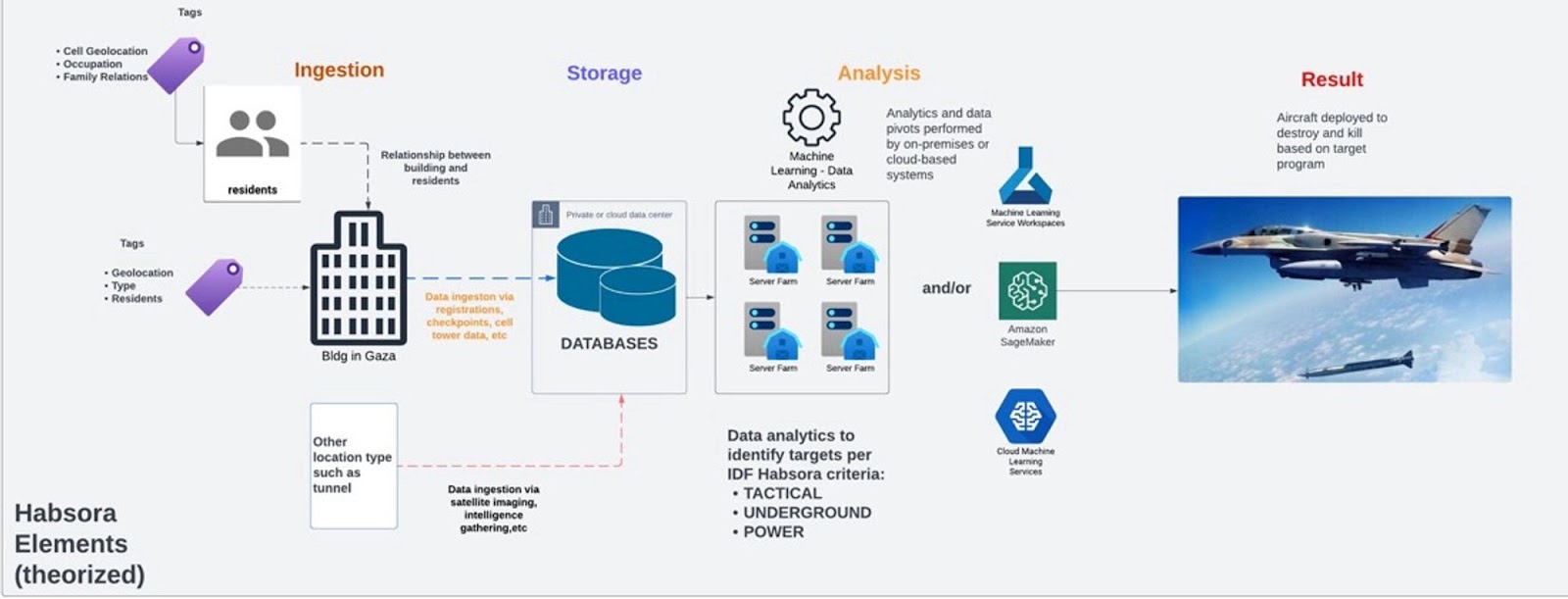
The reality is more mundane, more familiar, even banal; the components of this machine are constantly in use around us. Here is a graphic that shows some of the likely elements:
As we use our phones, register our locations, fill in online forms for business and government services, interact on social media and so many other things, we unknowingly create threads and weave patterns, stored in databases. The same type of system that enables a credit card fraud detection algorithm to block your card if in-person store transactions are registered in two, geographically distant locations on the same day can be used to build a map of your activities and relations to find and kill you and those you know and love. This is what the IDF has done with Habsora. The distance separating the intrusive methods of Meta, Google and fellow travelers from this killing machine is not as great as it seems.
Before being driven from their homes by the IDF – homes that were destroyed under the most intensive bombing campaign of this and perhaps even the previous, hyper-violent century, Palestinians in Gaza were subject to a program of surveillance and control which put them completely at the mercy of the Israeli government. All data about their movements and activities passed through electronic infrastructure owned and controlled by Israeli entities. This infrastructure, and the data processing and analysis built upon it, have been assembled into a factory whose product is death – whether targeted or en masse.
The Thin Curtain
Surveillance. Control. Punishment. This is what the age of digital computation has brought on an unprecedented scale. For those of us who live in places where the bombs don’t yet fall, there are things like the following, excerpted from the Forbes article (Feb 23, 2024) ‘Dozens Of KFC, Taco Bell And Dairy Queen Franchises Are Using AI To Track Workers’ –
Like many restaurant owners, Andrew Valkanoff hands out bonuses to employees who’ve done a good job. But at five of his Dairy Queen franchises across North Carolina, those bonuses are determined by AI.
The AI system, called Riley, collects streams of video and audio data to assess workers’ performance, and then assigns bonuses to those who are able to sell more. Valkanoff installed the system, which is developed by Rochester-based surveillance company Hoptix, less than a year ago with the hopes that it would help increase sales at a time when margins were shrinking and food and labor costs were skyrocketing.
Inside the zone of comparative safety but, deprivation for many and control imposed on all, there are systems like the IDF’s Habsora in service, employing the same computational techniques, which, instead of directing sniper rifle armed quadcopters and F-16s on deadly errands, deprive people of jobs, medical care and freedom. Just as a rocket’s payload can be changed from peaceful to fatal ends, the intended outcomes of such systems can be altered to fit the goals of the states that employ them.
The Shadow
As I write this, approximately 1.4 million Palestinians have been violently pushed to Rafah, a city in the southern Gaza strip. There, they are facing starvation and incomprehensible cruelty. Meanwhile, southwest of the ruins of Gaza City, in what has come to be known as the Al Nabulsi massacre, over one hundred Palestians were killed by IDF fire while desperately trying to get flour. These horrors were accelerated by the use of computationally driven killing systems. In the wake of Habsora’s use in what journalist Antony Loewenstein calls the Palestine Laboratory, we should expect similar techniques to be used elsewhere and to become a standard part of the arsenal of states (yes, even those we call democratic) in their efforts to impose their will on an ever more restless world that struggles for freedom.
References
Artificial intelligence and insurance, part 1: AI’s impact on the insurance value chain
The IDF assault on Nasser hospital in Southern Gaza joined a long and growing list of bloody infamies committed by Israel since Oct 7, 2023. During a Democracy Now interview, broadcast on Feb 15, 2024, Dr. Khaled Al Serr, who was later kidnapped by the IDF, described what he saw:
“Actually, the situation here in the hospital at this moment is in chaos. All of the patients, all the relatives, refugees and also the medical staff are afraid because of what happened. We could not imagine that at any time the Israeli army will bomb the hospital directly, and they will kill patients and medical personnel directly by bombing the hospital building. Yesterday also, Israeli snipers and Israeli quadcopters, which is a drone, carry on it an AR, and with a sniper, they shot all over the building. And they shot my colleague, Dr. Karam. He has a shrapnel inside his head. I can upload for you a CT for him. You can see, alhamdulillah, it was superficial, nothing serious. But a lot of bullets inside their bedroom and the restroom.”
The Israeli military is using quadcopters, armed with sniper rifles, as part of its assassination arsenal. These remote operated drones, which possess limited but still important automatic capabilities (flight stability, targeting persistence) are being used in the genocidal war in Gaza and the war between Russia and Ukraine to name two, prominent examples. They are likely to make an appearance near you in some form, soon enough.
I haven’t seen reporting on the type of quadcopter used but it’s probably the Smash Dragon, a model produced by the Israeli firm Smart Shooter which, on its website, describes its mission:
SMARTSHOOTER develops state-of-the-art Fire Control Systems for small arms that significantly increase weapon accuracy and lethality when engaging static and moving targets, on the ground and in the air, day and night.
Here is a promotional video for the Smash Dragon:
Smart Shooter’s product, and profit source are the application of computation to the tasks of increasing accuracy and automating weapon firing. One of their ‘solutions’ (solving, apparently, the ‘problem’ of people being alive) is a fixed position ‘weapon station’ called the Smash Hopper that enables a distant operator to target-lock the weapon on a person, initiating the firing of a constant stream of bullets. For some reason, the cartoonish word, ‘smash’ is popular with the Smart Shooter marketing team.
‘AI’, as used under the current global order, serves three primary purposes: control via sorting, anti-labor propaganda and obscuring culpability. Whenever a hospital deploys an algorithmic system, rather than healthcare worker judgment, to decide how long patients stay, sorting is being used as a means of control, for profit. Whenever a tech CEO tells you that ‘AI’ can replace artists, drivers, filmmakers, etc. the idea of artificial intelligence is employed as an anti-labor propaganda tool. And whenever someone tells you that the ‘AI’ has decided, well, anything, they are trying to hide the responsibility of the people behind the scenes, pushing algorithmic systems on the world.
The armed quadcopter brings all of these purposes together, wrapped in a blood stained ribbon. Who lives and who dies is decided via remote control while the fingers pulling the trigger, and the people directing them are hidden from view. These systems are marketed as using ‘AI’ implying machines are making life and death decisions rather than people.
In the introduction to his 2023 book, The Palestine Laboratory, which details Israel’s role in the global arms trade and use of the Palestinians as lethal examples, journalist Anthony Lowenstein describes a weapons demonstration video attended by Andrew Feinstein in 2009:
“Israel is admired as a nation that stands on its own and is unashamed in using extreme force to maintain it. [Andrew Feinstein is] a former South African politician. journalist, and author. He told me about attending the Paris Air Show in 2009, the world’s largest aerospace industry and air show exhibitions. [The Israel-based defense firm Elbit Systems] was showing a promotional video about killer drones, which have been used in Israel’s war against Gaza and over the West Bank.
The footage had been filmed a few months before and showed the reconnaissance of Palestinians in the occupied territories. A target was assassinated. […] Months later, Feinstein investigated the drone strike and discovered that the incident featured in the video had killed a number of innocent Palestinians, including children. This salient fact wasn’t featured at the Paris Air Show. “This was my introduction to the Israeli arms industry and the way it markets itself.”
The armed quadcopter drone, one of the fruits of an industry built on occupation and death, can be added to the long list of the harms of computation. ‘Keep watching the skies!’ someone said at the end of a 1950s science fiction film whose name escapes me. Never mind though, the advice stands.
Confirmed: Dr. Khaled Al Serr, who took a lead role in trying to inform western press of the consequences of Israel’s attack on Nasser Hospital, has been abducted. Statement: https://t.co/ETI2hbcegzpic.twitter.com/emMypy29bD
This is written in the spirit of the Request for Comments memorandums that shaped the early Internet. RFCs, as they are known, are submitted to propose a technology or methodology and gather comments/corrections from relevant and knowledgeable community members in the hope of becoming a widely accepted standard.
Purpose
This is a consideration of the information technology options for politically and socially active organizations. It’s also a high level overview of the technical landscape. The target audience is technical decision makers in groups whose political commitments challenge the prevailing order, focused on liberation. In this document, I will provide a brief history of past patterns and compare these to current choices, identifying the problems of various models and potential opportunities.
Alongside this blog post there is a living document posted for collaboration here. I invite a discussion of ideas, methods and technologies I may have missed or might be unaware of to improve accuracy and usefulness.
Being Intentional About Technology Choices
It is a truism that modern organizations require technology services. Less commonly discussed are the political, operational, cost and security implications of this dependence from the perspective of activists. It’s important to be intentional about technological choices and deployments with these and other factors in mind. The path of least resistance, such as choosing Microsoft 365 for collaboration rather than building on-premises systems, may be the best, or least terrible choice for an organization but the decision to use it should come after weighing the pros and cons of other options. What follows is not an exhaustive history; I am purposefully leaving out many granular details to get to the point as efficiently as possible.
A Brief History of Organizational Computing
By ‘organizational computing’ I’m referring to the use of digital computers arranged into service platforms by non-governmental and non-military organizations. In this section, there is a high level walk through of the patterns which have been utilized in this sector.
Mainframes
IBM 360 in Computer Room – mid 1960s
The first use of digital computing at-scale was the deployment of mainframe systems as centrally hosted resources. User access, limited to specialists, was provided via a time sharing method in which ‘dumb’ terminals displayed results of programs and enabled input (punch cards were also used for inputting program instructions). One of the most successful systems was the IBM 360 (operational from 1965 to 1978). Due to expense, the typical customer was large banks, universities and other organizations with deep pockets.
Client Server
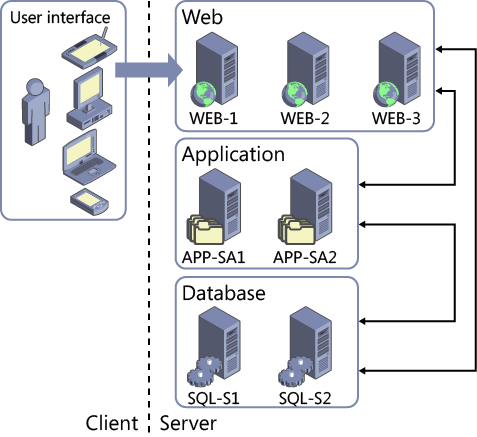
Classic Client Server Architecture (Microsoft)
The introduction of personal computers in the 1980s created the raw material for the development of networked, smaller scale systems that could supplement mainframes and provide organizations with the ability to host relatively modest computing platforms that suited their requirements. By the 1990s, this became the dominant model used by organizations at all scales (mainframes remain in service but the usage profile became narrower – for example, to run applications requiring greater processing capability than what’s possible using PC servers).
The client server model era spawned a variety of software applications to meet organizational needs such as email servers (for example, Sendmail and Microsoft Exchange), database servers (for ex. Postgres and SQL Server), web servers such as Apache and so on. Companies such as Novell, Cisco, Dell and Microsoft rose to prominence during this time.
As the client server era matured and the need for computing power grew, companies like VMWare sold platforms that enabled the creation of virtual machines (software mimics of physical servers). Organizations that could not afford to own or rent large data centers could deploy the equivalent of hundreds or thousands of servers within a smaller number of more powerful (in terms of processing capacity and memory) computing systems running VMWare’s ESX software platform. Of course, the irony of this return to something like a mainframe was not lost on information technology workers whose careers spanned the mainframe to client server era.
Cloud computing
Cloud Pattern (Amazon Web Services)
Virtualization, combined with the improved Internet access of the early 2000s, gave rise to what is now called ‘cloud.’ Among information technology workers, it was popular to say ‘there is no cloud, it’s just someone else’s computer.’ Overconfident cloud enthusiasts considered this to be the complaint of a fading old guard but it is undeniably true.
The Cloud Model
There are four modes of cloud computing:
Infrastructure as a service – IaaS: (for example, building virtual machines on platforms such as Microsoft Azure, Amazon Web Services or Google Cloud Platform)
Platform as a service – PaaS: (for example, databases offered as a service utility eliminating the need to create a server as host)
Software as a Service – SaaS: (platforms like Microsoft 365 fall into this category)
Function as a Service – FaaS: (focused on deployment using software development – ‘code’ – alone with no infrastructural management responsibilities)
A combination of perceived (but rarely realized) convenience, marketing hype and mostly unfulfilled promises of lower running costs have made the cloud model the dominant mode of the 2020s. In the 1990s and early 2000s, an organization requiring an email system was compelled to acquire hardware and software to configure and host their own platform (the Microsoft Exchange email system running on Dell server or VMWare hardware was a common pattern). The availability of Office 365 (later, Microsoft 365) and Google’s G-Suite provided another, attractive option that eliminated the need to manage systems while providing the email function.
A Review of Current Options for Organizations
Although tech industry marketing presents new developments as replacing old, all of the pre-cloud patterns mentioned above still exist. The question is, what makes sense for your organization from the perspectives of:
Cost
Operational complexity
Maintenance complexity
Security and exposure to vulnerabilities
Availability of skilled workers (related to the ability to effectively manage all of the above)
We needn’t include mainframes in this section since they are cost prohibitive and today, intended for specialized, high performance applications.
Client Server (on-premises)
By ‘on-premises’ we are referring to systems that are not cloud-based. Before the cloud era, the client server model was the dominant pattern for organizations of all sizes. Servers can be hosted within a data center the organization owns or within rented space in a colocation facility (a business that provides rented space for the servers of various clients).
Using a client server model requires employing staff who can install, configure and maintain systems. These skills were once common, indeed standard, and salaries were within the reach of many mid-size organizations. The cloud era has made these skills harder to come by (although there are still many skilled and enthusiastic practitioners). A key question is, how much investment does your organization want to make in the time and effort required to build and manage its own system? Additional questions for consideration come from software licensing and software and hardware maintenance cycles.
Sub-categories of client server to consider
Virtualization and Hyper-converged hardware
As mentioned above, the use of virtualization systems, offered by companies such as VMWare, was one method that arose during the heyday of client server to address the need for more concentrated computing power in a smaller data center footprint.
Hyper-converged infrastructure (HCI) systems, combining compute, storage and networking into a single hardware chassis, is a further development of this method. HCI systems and virtualization reduce the required operational overhead. More about this later.
Hybrid architectures
A hybrid architecture uses a mixture of on-premises and off-site, typically ‘cloud’ based systems. For example, an organization’s data might be stored on-site but the applications using that data are hosted by a cloud provider.
Cloud
Software as a Service
Software as a Service platforms such as Microsoft 365 are the most popular cloud services used by firms of all types and sizes, including activist groups. The reasons are easy to understand:
Email services without the need to host an email server
Collaboration tools (SharePoint and MS Teams for example) built into the standard licensing schemes
Lower (but not zero) operational responsibility
Hardware maintenance and uptime are handled by the service provider
The convenience comes at a price, both financial, as licensing costs increase and operational inasmuch as organizations tend to place all of their data and workflows within these platforms, creating deep dependencies.
Build Platforms
The use of ‘build platforms’ like Azure and AWS is more complex than the consumption model of services such as Microsoft 365. Originally, these were designed to meet the needs of organizations that have development and infrastructure teams and host complex applications. More recently, the ‘AI’ hype push has made these platforms trojan horses for pushing hyperscale algorithmic platforms (note, as an example, Microsoft’s investment in and use of OpenAI’s Large Language Model kit) The most common pattern is a replication of large-scale on-premises architectures using virtual machines on a cloud platform.
Although marketed as superior to, and simpler than on-premises options, cloud platforms require as much, and often more technical expertise. Cost overruns are common; cloud platforms make it easy to deploy new things but each item generates a cost. Even small organizations can create very large bills. Security is another factor; configuration mistakes are common and there are many examples of data breaches produced by error.
Private Cloud
The potential key advantage of the cloud model is the ability to abstract technical complexity. Ideally, programmers are able to create applications that run on hardware without the requirement to manage operating systems (a topic outside of the scope of this document). Private cloud enables the staging of the necessary hardware on-premises. A well known example is Openstack which is very technically challenging. Commercial options include Microsoft’s Azure Stack which extends the Azure technology method to hyper converged infrastructure (HCI) hosted within an organization’s data center.
Information Technology for Activists – What is To Be Done?
In the recent past, the answer was simple: purchase hardware and software and install and configure it with the help of technically adept staff, volunteers or a mix. In the 1990s and early 2000s it was typical for small to midsize organizations to have a collection of networked personal computers connected to a shared printer within an office. Through the network (known as a local area network or LAN) these computers were connected to more powerful computers called servers that provide centralized storage and the means through which each individual computer could communicate in a coordinated manner and share resources. Organizations often hosted their own websites which were made available to the Internet via connections from telecommunications providers.
Changes in the technology market since the mid 2000s, pushed to increase the market dominance and profits of a small group of firms (primarily, Amazon, Microsoft and Google) have limited options even as these changes appear to offer greater convenience. How can these constraints be navigated?
Proposed Methodology and Doctrines
Earlier in this document, I mentioned the importance of being intentional about technology usage. In this section, more detail is provided.
Let’s divide this into high level operational doctrines and build a proposed architecture from that.
First Doctrine: Data Sovereignty
Organizational data should be stored on-premises using dedicated storage systems rather than in a SaaS such as Microsoft 365 or Google Workspace
Second Doctrine: Bias Towards Hybrid
By ‘hybrid’ I am referring to system architectures that utilize a combination of on-premises and ‘cloud’ assets
Third Doctrine: Bias Towards System Diversity
This might also be called the right tool for the right job doctrine. After consideration of relevant factors (cost, technical ability, etc) an organization may decide to use Microsoft 365 (for example) to provide some services but other options should be explored in the areas of:
Document management and related real time collaboration tooling
Online Meeting Platforms
Database platforms
Email platforms
Commercial platforms offer integration methods between platforms that make it possible to create an aggregated solution from disparate tools.
These doctrines can be applied as guidelines for designing an organizational system architecture:
The above is only one option. More are possible depending on the aforementioned factors of:
Cost
Operational complexity
Maintenance complexity
Security and exposure to vulnerabilities
Availability of skilled workers (related to the ability to effectively manage all of the above)
I invite others to add to this document to improve its content and sharpen the argument.
Activist Documents and Resources Regarding Alternative Methods
Counter Cloud Action Plan – The Institute for Technology In the Public Interest
On September 14, 2023, while touring Twitter the way you might survey the ruins of Pompey, I came across a series of posts responding to this statement from the EU Commission account:
Mitigating the risk of extinction from AI should be a global priority…
What attracted critical attention was the use of the phrase, ‘risk of extinction‘ a fear of which, as Dr. Timnit Gebru alerts us (among others, mostly women researchers I can’t help but notice) lies at the heart of what Gebru calls the ´TESCREAL Bundle.’ The acronym, TESCREAL, which brings together the terms Transhumanism, Extropianism, Singularitarianism, Cosmism, Rationalism, Effective Altruism and Longtermism, describes an interlocked and related group of ideologies that have one idea in common: techno-utopianism (with a generous helping of eugenics and racialized ideas of what ‘intelligence’ means mixed in to make everything old new again).
Risk of extinction. It sounds dramatic, doesn’t it? The sort of phrase you hear in a Marvel movie, Robert Downey Jr, as Iron Man stands in front of a green screen and turns to one of his costumed comrades as some yet to be added animated threat approaches and screams about the risk of extinction if the animated thing isn’t stopped. There are, of course, actual existential risks; asteroids come to mind and although climate change is certainly a risk to the lives of billions and the mode of life of the industrial capitalist age upon which we depend, it might not be ‘existential’ strictly speaking (though, that’s most likely a distinction without a difference as the seas consume the most celebrated cities and uncelebrated communities).
The idea that what is called ‘AI’ – which, when all the tech industry’s glittering makeup is removed, is revealed plainly to be software, running on computers, warehoused in data centers – poses a risk of extinction requires a special kind of gullibility, self interest, and, as Dr, Gebru reminds us, supremacist delusions about human intelligence to promote, let alone believe.
***
In the picture posted to X, Ursula von der Leyen, President of the European Commission, is standing at a podium before the assembled group of commissioners, presumably in the EU Commission building (the Berlaymont) in Brussels, a city I’ve visited quite a few times, regretfully. The building itself and the main hall for commissioners, are large and imposing, conveying, in glass, steel and stone, seriousness. Of course, between the idea and the act there usually falls a long shadow. How serious can this group be, I wondered, about a ‘risk of extinction’ from ‘AI’?
***
To find out, I decided to look at the document referenced and trumpeted in the post, the EU Artificial Intelligence Act. There’s a link to the act in the reference section below. My question was simple: is there a reference to ‘risk of extinction’ in this document? The word, ‘risk’, appears 71 times. It’s used in passages such as the following, from the overview:
The Commission proposes to establish a technology-neutral definition of AI systems in EU law and to lay down a classification for AI systems with different requirements and obligations tailored on a ‘risk-based approach’. Some AI systems presenting ‘unacceptable’ risks would be prohibited. A wide range of ‘high-risk’ AI systems would be authorised, but subject to a set of requirements and obligations to gain access to the EU market.
The emphasis is on a ‘risk based approach’ which seems sensible at first look but there are inevitable problems and objections. Some of the objections come from the corporate sector, claiming, with mind-deadening predictability, that any and all regulation hinders ‘innovation’ a word that is invoked like an incantation only not as intriguing or lyrical. More interesting critiques come from those who see risk (though, notably, not existential) and who agree something must be done but who view the EU’s act as not going far enough or going in the wrong direction.
Here is the listing of high-risk activities and areas for algorithmic systems in the EU Artificial Intelligence Act:
o Biometric identification and categorisation of natural persons
o Management and operation of critical infrastructure
o Education and vocational training
o Employment, worker management and access to self-employment
o Access to and enjoyment of essential private services and public services and benefits
o Law enforcement
o Migration, asylum and border control management
o Administration of justice and democratic processes
Missing from this list is the risk of extinction; which, putting aside the Act’s flaws, makes sense. Including it would have been as out of place in a consideration of real-world harms as adding a concern about time traveling bandits.. And so, now we must wonder, why include the phrase, “risk of extinction” in a social media post?
***
On March 22, 2023, the modestly named Future of Life Institute, an organization initially funded by the bathroom fixture toting Lord of X himself, Musk (a 10 million USD investment in 2015) whose board is as alabaster as the snows of Antarctica once were, kept afloat by donations from other tech besotted wealthies, published an open letter titled, ‘Pause Giant AI Experiments: An Open Letter.’ This letter was joined by similarly themed statements from OpenAI (‘Planning for AGI and beyond’) and Microsoft (‘Sparks of Artificial General Intelligence: Early experiments with GPT-4’).
Each of these documents has received strong criticism from people, such as yours truly, and others with more notoriety and for good reason: they promote the idea that the imprecisely defined Artificial General Intelligence (AGI) is not only possible, but inevitable. Critiques of this idea – whether based on a detailed analysis of mathematics (‘Reclaiming AI as a theoretical tool for cognitive science’) or of computational limits (The Computational Limits of Deep Learning) have the benefit of being firmly grounded in material reality.
But as Freud might have warned us, we live in a society shaped not only by our understanding of the world as it is but also, in no small part by dreams and fantasies. White supremacists harbor the self congratulating fantasy that any random white person (well, man) is an astounding genius when compared to those not in that club. This notion endures despite innumerable and daily examples to the contrary because it serves the interests of certain individuals and groups to persist in delusion and impose this delusion on the world. The ‘risk of extinction’ fantasy has caught on because it builds on decades of fiction, like the idea of an American Dream and adds spice to an otherwise deadly serious and grounded business: controlling the tech industry’s scope of action. Journalists who ignore the actual harms of algorithmic systems rush to write stories about a ‘risk of extinction’ which is far sexier than talking about the software now called ‘AI’ that is used to deny insurance benefits or determine criminal activity.
The European Union’s Artificial Intelligence Act does not explicitly reference ‘existential risk’ but the social media post using this idea is noteworthy. It shows that lurking in the background, the ideas promoted by the tech industry – by OpenAI and its paymaster Microsoft and innumerable camp followers – have seeped into the thinking of decision makers at the highest levels.
And how could it be otherwise? How flattering to think you’re rescuing the world from Skynet, the fictional, nuclear missile tossing system featured in the ‘Terminator’ franchise, rather than trying, at long last, to actually regulate Google.
There’s a story we tell ourselves, a lullaby, really, which is that science fiction is a predictor of the terrain of that magical land, always just over the horizon, ‘the future.’ This story is deeply embedded in the consciousness of US’ians, (no, I’m not calling people from the US alone ‘Americans’ as if the rest of the Americas is in another hemisphere) even by people who don’t care for stories about spacecraft, robots and malevolent AI (always malevolent, for some reason, a sign of some aspect of US thinking requiring psychoanalytic investigation).
The evidence for this tendency is all around us; every ‘Black Mirror’ episode, for example, is treated as if it’s a prognostication from Nostradamus; the same tired tales of out of control AI, murderous machines and derelict space colonies cycled again and again, each time treated like a bold revelation of Things to Come.
Of course, there is real technological change; we have mobile, computer radio phones with glass screens and ICBMs, things our great grandparents would have found miraculous for a little while before the phone bills came due and the nuclear missiles, patiently waiting in their silos, were forgotten to aid sleep. It’s undeniable that we live in a world shaped by applied scientific inquiry and technological modification. These things have a social impact and fashion our political economy, driven by profit motivations. That’s the reality; the idea there’s a feedback loop between science fiction and what someone will breathlessly shout to be ‘science fact!’ is not entirely bankrupt, but there’s a mustiness to it, it smells like mouldy bread, slathered in butter and presented as still fresh.
…
All of which brings me to an essay published in the Atlantic “When Sci-Fi Anticipates Reality.” There’s a laziness to this piece which may not be the author – Lora Kelley’s fault – after all, the topic itself is weary.
Here’s an excerpt:
Reading about this news, [Meta adding legs to avatars] I told my editor—mostly as a joke—that the metaverse users interested in accessing alternative realities and stepping into other lives should consider simply reading a novel. I stand by that cranky opinion, but it also got me thinking about the fact that the metaverse actually owes a lot to the novel. The term metaverse was coined in a 1992 science-fiction novel titled Snow Crash. (The book also helped popularize the term avatar, to refer to digital selves.) And when you start to look for them, you can find links between science fiction and real-world tech all over.
The word “cranky” is used and I admit to feeling a bit cranky myself after reading this attempt to link a product Meta is struggling to make viable (using actual computers requiring power and labor) with a term from a novel as old as someone with credit problems. There’s about as much of a connection between the ‘metaverse’ nightmaringly imagined in Snow Crash and what Meta is capable of as between a piece of paper upon which someone has written the word, ‘laser’ and an actual laser.
A bit later in the piece, another favorite of the science fiction to fact genre gets its time in the sun, ‘anticipation’ –
Ross Andersen, an Atlantic writer who covers science and technology, also told me he suspects that “a messy feedback loop” operates between sci-fi and real-world tech. Both technologists and writers who have come up with fresh ideas, he said, “might have simply been responding to the same preexisting human desires: to explore the deep ocean and outer space, or to connect with anyone on Earth instantaneously.” Citing examples such as Jules Verne’s novels and Isaac Asimov’s stories, Ross added that “whether or not science fiction influenced technology, it certainly anticipated a lot of it.”
Leaving aside the question of whether there is indeed a “preexisting human desire” to explore outer space (and thus far, almost all of our examples of ‘exploration’ have been for exploitation so one wonders if other desires were being met) there’s an ironic assertion that ‘fresh ideas’ are what’s on offer. Fresh ideas, like a warmed over Second Life platform based, in name if not experienced reality, on a decades old novel.
…
2023 is not the year of bold new visions, brought to life by intrepid scientists and technologists inspired by science fiction (it’s always warmed over cyberpunk and Asimov, never Stanislaw Lem, I note). It’s the year in which the industry runs, like a rat in flames, from one thing to another – crypto, web3, metaverse, AI, generative AI and chatbots for every task. This isn’t evidence of a ‘messy feedback loop’ but of an emptiness, a void. The bag of tricks is almost empty. Where will the new profits come from?
Perhaps there is a feedback loop after all, from stale idea to stale implementation, all wrapped in a marketing bow and sold as new when it’s as old as a Jules Verne novel.
In this essay, published for The Nation magazine, I argue that the primarily purpose of the application of generative methods to the production of images (what some insist upon calling AI art) is the creation of an assembly line.
When we think about the tech industry, images of smoothly functioning machines, moving the world inexorably towards a brilliant future, may dance across your mind. This is no accident; the industry, since its birth in the 1990s (in its present form, deriving profits from software and the proliferation of software methods as broadly as possible) has cultivated and encouraged this view with the help of an uncritical tech press.
What’s lacking is a consideration and acknowledgement of the materialist aspects of the industry. By ‘materialist’ I’m referring to the nuts and bolts of how things work: the actual business of software and its place within political economy. Although the tech industry, with its flair for presentation and compliant press coverage, has successfully sold itself as fundamentally different from other economic sectors (say, coal mining) what it shares with all other forms of business activity within capitalism is an emphasis on profit as the only true goal. Once we re-center an understanding of profit as the objective, things that seem inexplicable or against a corporation’s ‘culture’ come into focus.
Which brings me to Microsoft and my new podcast.
For decades – almost since the company hit its near monopoly stride as an arbiter of desktop software used by companies large and small and consumers – I have worked with Microsoft technologies at what, in the industry, is called ‘at-scale’ for multinational companies across the globe. This has provided me with an understanding of two sides of a coin: how Microsoft works and how its software and other products are used by its corporate customers. From SQL Server databases for banks to Azure cloud hosted machine learning APIs used by so called AI start-ups, I have seen, and continue to see, if not all, a very broad swath.
This is the basis for an analysis of Microsoft from a materialist perspective. Capitalism, from this view, is not taken as a given but as a system which developed over time and was imposed upon the world. In this podcast, we will use Microsoft as the focal point for a review of the software aspect of this system in its present form. I hope you come along.
Several years ago, there was a mini-trend of soft documentaries depicting what would happen to the built environment if humans somehow disappeared from the Earth. How long, for example, would untended skyscrapers punch against the sky before they collapsed in spectacular, downward cascading showers of steel and glass onto abandoned streets? These are the sorts of questions posed in these films.
As I watched these soothing depictions of a quieter world, I sometimes imagined a massive orbital tombstone, perhaps launched by the final rocket engineers, onto which was etched: Wasted Potential.
While I type these words, billions of dollars have been spent on and barely tabulated amounts of electrical power, water and human labor (barely tabulated, because deliberately obscured) have been devoted to large language model (LLM) systems such as ChatGPT. If you follow the AI critical space you’re familiar with the many problems produced by the use and promotion of these systems – including, on the hype end, the most recent gyration, a declaration of “existential risk” by a collection of tech luminaries (a category which, in a Venn diagram, overlaps with carnival barker). This use of mountains of resources to enhance the profit objectives of Microsoft, Amazon and Google, among other firms not occupying their olympian perches, is wasted potential in frenetic action.
But what of alternative visions? They exist, all is not despair. The dangerous nonsense relentlessly spewing from the AI industry is overwhelming and countering it is a full time pursuit. But we can’t stay stuck, as if in amber, in a state of debunking and critique. There must be more. I recommend the DAIR Institute and Logic(s) magazine as starting points for exploring other ways of thinking about applied computation. Ideologically, AI doomerism is fueled in large measure by dystopian pop sci-fi such as Terminator. You know the story, which is a tale as old as the age of digital computers: a malevolent supercomputer – Skynet (a name that sounds like a product) – launches, for some reason, a war on humanity, resulting in near extinction. The tech industry seems to love ripping dystopian yarns. Judging by the now almost completely forgotten metaverse push (a year ago, almost as distant as the pleistocene in hype cycle time), inspired by the less than sunny sci-fi novel Snow Crash, we can even say that dystopian storylines are a part of business plans (what is the idea of sitting for hours wearing VR goggles if not darkly funny?).
There are also less terrible, even hopeful, fictional visions, presented via pop science fiction such as Star Trek´s Library Computer Access/Retrieval System – LCARS.
In the Star Trek: The Next Generation episode, “Booby Trap” the starship Enterprise is caught in a trap, composed of energy sapping fields, that prevents it from using its most powerful mode of propulsion, warp drive. The ship’s chief engineer, Geordi LeForge, is given the urgent task of finding a solution. LeForge realizes that escaping this trap requires a re-configuration, perhaps even a new understanding, of the ship’s propulsion system. That’s the plot but most intriguing to me is the way LeForge goes about trying to find a solution.
The engineer uses the ship’s computer – the LCARS system – to do a retrieval and rapid parsing of the text of research and engineering papers going back centuries. He interacts with the computer via a combination of audio and keyboard/monitor. Eventually, LeForge resorts to a synthetic, holo mockup of the designer of the ship’s engines, Dr. Leah Brahms, raising all manner of ethical issues but we needn’t bother with that plot element.
I’ve created a high level visualisation of how this fictional system is portrayed in the episode:
The ability to identify text via search, to summarize and read contents (with just enough contextual capability to be useful) and to output relevant results is rather close, conceptually, to the potential of language models. The difference between what we actually have – competing and discrete systems owned by corporations – and LCARS (besides many orders of magnitude of greater sophistication in the fictional system) is that LCARS is presented as an integrated, holistic and scoped system. LCARS’ design is to be a library that enables access to knowledge and retrieves results based on queried criteria.
There is a potential, latent within language models and hybrid systems – indeed, within almost the entire menagerie of machine learning methods – to create a unified computational model for a universally useful platform. This potential is being wasted, indeed, suppressed as oceans of capital, talent and hardware is poured into privately owned things such as ChatGPT. There are hints of this potential found within corporate spaces; Meta’s LLaMA, which leaked online, shows one avenue. There are surely others.
Among a dizzying collection of falsehoods, the tech industry’s greatest lie is that it is building the future. Or perhaps, I should sharpen my description: the industry may indeed be building the future but contrary to its claims, it is not a future with human needs centered. It is possible however, to imagine and build a different computation and we needn’t turn to Silicon Valley’s well thumbed library of dystopian novels to find it. Science fiction such as Star Trek (I’m sure there are others) provide more productive visions
What should we think about AI? To corporate boosters and their camp followers (an army of relentless shouters) , so-called artificial intelligence is a world altering technology, sweeping across the globe like a wave made from the plots of forgotten science fiction novels. Among critics, thoughts are more varied. Some focus on debunking hyped claims, others, on the industry’s racist conceptions (such as the presentation of a cohort of men, mostly White, who work with ‘code’ as being the pinnacle of human achievement) and still others, on the seldom examined ideology of ‘intelligence’ itself.
For Dan McQuillan, author of the taut (seven chapters) yet expansive book, ‘Resisting AI: An Anti-Facist Approach to Artificial Intelligence’ AI, is, under current conditions but not inherently, the computational manifestation of ever present fascist ideologies of control, categorization and exclusion. McQuillan has written a vital manifesto, the sort of work which, many years from now, may be recalled, if we’re fortunate, as being among the defining calls to arms of its age. In several interviews (including this one for Machine Learning Street Talk) McQuillan has described the book’s origin as a planned, scholarly review of the industry that, as its true state became clearer to him, evolved into a warning.
We can be glad he had the courage to follow the evidence where it led.
Both In and Of the World
“The greatest trick the Devil ever pulled” the saying goes, “was convincing the world he doesn’t exist.” The tech industry, our very own Mephistopheles (though lacking the expected fashion sense) has pulled a similar trick with ‘AI’ convincing us that, alone among technical methods, it exists as a force disconnected from the world’s socio-political concerns. In short order, McQuillan dispenses with this in the introduction:
It would be troubling enough if AI was a technology being tested in the lab or applied in a few pioneering startups, but it already has huge institutional and cultural momentum. […] AI derives a lot of its authority from its association with methods of scientific analysis, especially abstraction and reduction, an association which also fuels the hubris of some of its practitioners. The roll out of AI across swathes of industry doesn’t so much lead to a loss of jobs as to an amplification of casualized and precarious work. [emphasis mine] Rather than being an apocalyptic technology, AI is more aptly characterized as a form of supercharged bureaucracy that ramps up everyday cruelties, such as those in our systems of welfare. In general, […] AI doesn’t lead to a new dystopia ruled over by machines but an intensification of existing misery through speculative tendencies that echo those of finance capital. These tendencies are given a particular cutting edge by the way Al operates with and through race. AI is a form of computation that inherits concepts developed under colonialism and reproduces them as a form of race science. This is the payload of real AI under the status quo. [Introduction, pg 4]
Rather than acting as the bridge to an unprecedented new world, AI systems (really, statistical inference engines) are the perfect tool for the continuance of existing modes of control, intensified and excused by the cover of supposed silicon impartiality.
Later, in chapter two, titled, ‘AI Violence’ McQuillan sharpens his argument that the systems imposed on us are engines of automated abuse.
AI operationalizes [a] reductive view through its representations. […] , Aľ’s representations of the world consist of the set of weights in the [processing] layers plus the model architecture of the layers themselves. Like science, Al’s representations are presented as distinct from that which they claim to represent. In other words, there is assumed to be an underlying base reality that is independent of the practices by which such representations are constructed. But […] the entities represented by AI systems- the ‘careful Amazon driver’ or the ‘trustworthy citizen’- are partly constructed by the systems that represent them. AI needs to be understood not as an instrument of scientific measurement but as an apparatus that establishes ‘relations of becoming between subjects and representations. The subject co-emerges along with the representation. The society represented by AI is the one that it actively produces.
We are familiar with the categories McQuillan highlights such as ‘careful drivers’ from insurance and other industries and government agencies which use the tagging and statistical sorting of discrete attributes to manage people and their movements within narrow parameters. AI, as McQuillan repeatedly stresses, supercharges already existing methods and ways of thinking, embedded within system logic. We don’t get a future, we are trapped in a frozen present, in which new thinking and new arrangements are inhibited via the computational enforcement of past structures.
Necropolitics
For me, the most powerful diagnostic section of the book is chapter 4, ‘Necropolitics.’ Although McQuillan is careful to not declare AI systems fascist by nature (beginning the work of imagining other uses for computational infrastructure in Chapter 5, ‘Post Machinic Learning’) he does make the critical point that these systems, embedded within a fraying political economy, are being promoted and made inescapable at a moment of mounting danger:
Al is entangled with our systems of ordering society. […] It helps accelerate a shift towards far-right politics. AI is emerging from within a convolution of ongoing crises, each of which has the potential to be fascism-inducing, including austerity, COVID-19 and climate change. Alongside these there is an internal crisis in the ‘relations of oppression’, especially the general destabilization of White male supremacy by decolonial, feminist, LGBTQI and other social movements (Palheta, 2021). The enrollment of AI in the management of these various crises produces ‘states of exception’ – forms of exclusion that render people vulnerable in an absolute sense. The multiplication of algorithmic states of exception across carceral, social and healthcare systems makes visible the necropolitics of Al; that is, its role in deciding who should live and who should be allowed to die.
As 20th century Marxists were fond of saying, it is no accident that as the capitalist social order faces ever more significant challenges, ranging from demands from the multitudes subjected to its tyranny to the growing instability of nature itself as climate change’s impacts accelerate, there is a turn, by elites, to a technology of command and control to reassert some sense of order. McQuillan’s urgency is born of a recognition of global emergency and the ways the collection of computational methods called ‘AI’ is being marshalled to meet that emergency using what can clearly be identified as fascist approaches. There’s much more to say but I will leave it here so you can explore on your own. Resisting AI: An Anti-Facist Approach to Artificial Intelligence, is an important and necessary book.
As the hype, indeed, propaganda about AI and its supposed benefits and even dangers (such as the delusions about ‘superintelligence’ a red herring) are broadcast ever more loudly, we need a collectivity of counterbalancing ideas and voices. McQuillan has provided us with a powerful contribution.