The Interpretation of Tech Dreams – On the EU Commission Post

On September 14, 2023, while touring Twitter the way you might survey the ruins of Pompey, I came across a series of posts responding to this statement from the EU Commission account:

Mitigating the risk of extinction from AI should be a global priority…

What attracted critical attention was the use of the phrase, ‘risk of extinction‘ a fear of which, as Dr. Timnit Gebru alerts us (among others, mostly women researchers I can’t help but notice) lies at the heart of what Gebru calls the ´TESCREAL Bundle.’ The acronym, TESCREAL, which brings together the terms Transhumanism, Extropianism, Singularitarianism, Cosmism, Rationalism, Effective Altruism and Longtermism, describes an interlocked and related group of ideologies that have one idea in common: techno-utopianism (with a generous helping of eugenics and racialized ideas of what ‘intelligence’ means mixed in to make everything old new again).

Risk of extinction. It sounds dramatic, doesn’t it? The sort of phrase you hear in a Marvel movie, Robert Downey Jr, as Iron Man stands in front of a green screen and turns to one of his costumed comrades as some yet to be added animated threat approaches and screams about the risk of extinction if the animated thing isn’t stopped. There are, of course, actual existential risks; asteroids come to mind and although climate change is certainly a risk to the lives of billions and the mode of life of the industrial capitalist age upon which we depend, it might not be ‘existential’ strictly speaking (though, that’s most likely a distinction without a difference as the seas consume the most celebrated cities and uncelebrated communities).

The idea that what is called ‘AI’ – which, when all the tech industry’s glittering makeup is removed, is revealed plainly to be software, running on computers, warehoused in data centers – poses a risk of extinction requires a special kind of gullibility, self interest, and, as Dr, Gebru reminds us, supremacist delusions about human intelligence to promote, let alone believe. 

***

In the picture posted to X, Ursula von der Leyen, President of the European Commission, is standing at a podium before the assembled group of commissioners, presumably in the EU Commission building (the Berlaymont) in Brussels, a city I’ve visited quite a few times, regretfully. The building itself and the main hall for commissioners, are large and imposing, conveying, in glass, steel and stone, seriousness. Of course, between the idea and the act there usually falls a long shadow. How serious can this group be, I wondered, about a ‘risk of extinction’ from ‘AI’?

***

To find out, I decided to look at the document referenced and trumpeted in the post, the EU Artificial Intelligence Act. There’s a link to the act in the reference section below. My question was simple: is there a reference to ‘risk of extinction’ in this document? The word, ‘risk’, appears 71 times. It’s used in passages such as the following, from the overview:

The Commission proposes to establish a technology-neutral definition of AI systems in EU law and to lay down a classification for AI systems with different requirements and obligations tailored on a ‘risk-based approach’. Some AI systems presenting ‘unacceptable’ risks would be prohibited. A wide range of ‘high-risk’ AI systems would be authorised, but subject to a set of requirements and obligations to gain access to the EU market.

The emphasis is on a ‘risk based approach’ which seems sensible at first look but there are inevitable problems and objections. Some of the objections come from the corporate sector, claiming, with mind-deadening predictability, that any and all regulation hinders ‘innovation’ a word that is invoked like an incantation only not as intriguing or lyrical. More interesting critiques come from those who see risk (though, notably, not existential) and who agree something must be done but who view the EU’s act as not going far enough or going in the wrong direction. 

Here is the listing of high-risk activities and areas for algorithmic systems in the EU Artificial Intelligence Act:

o Biometric identification and categorisation of natural persons

o Management and operation of critical infrastructure

o Education and vocational training

o Employment, worker management and access to self-employment

o Access to and enjoyment of essential private services and public services and benefits

o Law enforcement

o Migration, asylum and border control management

o Administration of justice and democratic processes

Missing from this list is the risk of extinction; which, putting aside the Act’s flaws, makes sense. Including it would have been as out of place in a consideration of real-world harms as adding a concern about time traveling bandits.. And so, now we must wonder, why include the phrase, “risk of extinction” in a social media post?

***

On March 22, 2023, the modestly named Future of Life Institute, an organization initially funded by the bathroom fixture toting Lord of X himself, Musk (a 10 million USD investment in 2015) whose board is as alabaster as the snows of Antarctica once were, kept afloat by donations from other tech besotted wealthies, published an open letter titled, ‘Pause Giant AI Experiments: An Open Letter.’ This letter was joined by similarly themed statements from OpenAI (‘Planning for AGI and beyond’) and Microsoft (‘Sparks of Artificial General Intelligence: Early experiments with GPT-4’).

Each of these documents has received strong criticism from people, such as yours truly, and others with more notoriety and for good reason: they promote the idea that the imprecisely defined Artificial General Intelligence (AGI) is not only possible, but inevitable.  Critiques of this idea – whether based on a detailed analysis of mathematics (‘Reclaiming AI as a theoretical tool for cognitive science’) or of computational limits (The Computational Limits of Deep Learning) have the benefit of being firmly grounded in material reality. 

But as Freud might have warned us, we live in a society shaped not only by our understanding of the world as it is but also, in no small part by dreams and fantasies. White supremacists harbor the self congratulating fantasy that any random white person (well, man) is an astounding genius when compared to those not in that club. This notion endures despite innumerable and daily examples to the contrary because it serves the interests of certain individuals and groups to persist in delusion and impose this delusion on the world. The ‘risk of extinction’ fantasy has caught on because it builds on decades of fiction, like the idea of an American Dream and adds spice to an otherwise deadly serious and grounded business: controlling the tech industry’s scope of action. Journalists who ignore the actual harms of algorithmic systems rush to write stories about a ‘risk of extinction’ which is far sexier than talking about the software now called ‘AI’ that is used to deny insurance benefits or determine criminal activity.

 The European Union’s Artificial Intelligence Act does not explicitly reference ‘existential risk’ but the social media post using this idea is noteworthy. It shows that lurking in the background, the ideas promoted by the tech industry – by OpenAI and its paymaster Microsoft and innumerable camp followers – have seeped into the thinking of decision makers at the highest levels.

And how could it be otherwise? How flattering to think you’re rescuing the world from Skynet, the fictional, nuclear missile tossing system featured in the ‘Terminator’ franchise, rather than trying, at long last, to actually regulate Google.

***

References

European Union

A European approach to artificial intelligence

EU Artificial Intelligence  Act

EU Post on X

Critique

Timnit Gebru on Tescreal (YouTube)

The Acronym Behind Our Wildest AI Dreams and Nightmares (on TESCREAL)

The EU still needs to get its AI Act together

Reclaiming AI as a theoretical tool for cognitive science

The Computational Limits of Deep Learning

Boosterism

Pause Giant AI Experiments: An Open Letter

Planning for AGI and beyond

Sparks of Artificial General Intelligence: Early experiments with GPT-4

The Future Circles the Drain

There’s a story we tell ourselves, a lullaby, really, which is that science fiction is a predictor of the terrain of that magical land, always just over the horizon, ‘the future.’ This story is deeply embedded in the consciousness of US’ians, (no, I’m not calling people from the US alone ‘Americans’ as if the rest of the Americas is in another hemisphere) even by people who don’t care for stories about spacecraft, robots and malevolent AI (always malevolent, for some reason, a sign of some aspect of US thinking requiring psychoanalytic investigation).

The evidence for this tendency is all around us; every ‘Black Mirror’ episode, for example, is treated as if it’s a prognostication from Nostradamus; the same tired tales of out of control AI, murderous machines and derelict space colonies cycled again and again, each time treated like a bold revelation of Things to Come.

Of course, there is real technological change; we have mobile, computer radio phones with glass screens and ICBMs, things our great grandparents would have found miraculous for a little while before the phone bills came due and the nuclear missiles, patiently waiting in their silos, were forgotten to aid sleep. It’s undeniable that we live in a world shaped by applied scientific inquiry and technological modification. These things have a social impact and fashion our political economy, driven by profit motivations. That’s the reality; the idea there’s a feedback loop between science fiction and what someone will breathlessly shout to be ‘science fact!’ is not entirely bankrupt, but there’s a mustiness to it, it smells like mouldy bread, slathered in butter and presented as still fresh.

All of which brings me to an essay published in the Atlantic “When Sci-Fi Anticipates Reality.” There’s a laziness to this piece which may not be the author – Lora Kelley’s fault – after all, the topic itself is weary.

Here’s an excerpt:

Reading about this news, [Meta adding legs to avatars] I told my editor—mostly as a joke—that the metaverse users interested in accessing alternative realities and stepping into other lives should consider simply reading a novel. I stand by that cranky opinion, but it also got me thinking about the fact that the metaverse actually owes a lot to the novel. The term metaverse was coined in a 1992 science-fiction novel titled Snow Crash. (The book also helped popularize the term avatar, to refer to digital selves.) And when you start to look for them, you can find links between science fiction and real-world tech all over.

https://www.theatlantic.com/newsletters/archive/2023/08/science-fiction-technology/675206/

The word “cranky” is used and I admit to feeling a bit cranky myself after reading this attempt to link a product Meta is struggling to make viable (using actual computers requiring power and labor) with a term from a novel as old as someone with credit problems. There’s about as much of a connection between the ‘metaverse’ nightmaringly imagined in Snow Crash and what Meta is capable of as between a piece of paper upon which someone has written the word, ‘laser’ and an actual laser.

A bit later in the piece, another favorite of the science fiction to fact genre gets its time in the sun, ‘anticipation’ –

Ross Andersen, an Atlantic writer who covers science and technology, also told me he suspects that “a messy feedback loop” operates between sci-fi and real-world tech. Both technologists and writers who have come up with fresh ideas, he said, “might have simply been responding to the same preexisting human desires: to explore the deep ocean and outer space, or to connect with anyone on Earth instantaneously.” Citing examples such as Jules Verne’s novels and Isaac Asimov’s stories, Ross added that “whether or not science fiction influenced technology, it certainly anticipated a lot of it.”

https://www.theatlantic.com/newsletters/archive/2023/08/science-fiction-technology/675206/

Leaving aside the question of whether there is indeed a “preexisting human desire” to explore outer space (and thus far, almost all of our examples of ‘exploration’ have been for exploitation so one wonders if other desires were being met) there’s an ironic assertion that ‘fresh ideas’ are what’s on offer. Fresh ideas, like a warmed over Second Life platform based, in name if not experienced reality, on a decades old novel. 

2023 is not the year of bold new visions, brought to life by intrepid scientists and technologists inspired by science fiction (it’s always warmed over cyberpunk and Asimov, never Stanislaw Lem, I note). It’s the year in which the industry runs, like a rat in flames, from one thing to another – crypto, web3, metaverse, AI, generative AI and chatbots for every task. This isn’t evidence of a ‘messy feedback loop’ but of an emptiness, a void. The bag of tricks is almost empty. Where will the new profits come from?

Perhaps there is a feedback loop after all, from stale idea to stale implementation, all wrapped in a marketing bow and sold as new when it’s as old as a Jules Verne novel. 

Microsoft: A Materialist Approach

When we think about the tech industry, images of smoothly functioning machines, moving the world inexorably towards a brilliant future, may dance across your mind. This is no accident; the industry, since its birth in the 1990s (in its present form, deriving profits from software and the proliferation of software methods as broadly as possible) has cultivated and encouraged this view with the help of an uncritical tech press.

What’s lacking is a consideration and acknowledgement of the materialist aspects of the industry. By ‘materialist’ I’m referring to the nuts and bolts of how things work: the actual business of software and its place within political economy. Although the tech industry, with its flair for presentation and compliant press coverage, has successfully sold itself as fundamentally different from other economic sectors (say, coal mining) what it shares with all other forms of business activity within capitalism is an emphasis on profit as the only true goal. Once we re-center an understanding of profit as the objective, things that seem inexplicable or against a corporation’s ‘culture’ come into focus.

Which brings me to Microsoft and my new podcast.

For decades – almost since the company hit its near monopoly stride as an arbiter of desktop software used by companies large and small and consumers – I have worked with Microsoft technologies at what, in the industry, is called ‘at-scale’ for multinational companies across the globe. This has provided me with an understanding of two sides of a coin: how Microsoft works and how its software and other products are used by its corporate customers. From SQL Server databases for banks to Azure cloud hosted machine learning APIs used by so called AI start-ups, I have seen, and continue to see, if not all, a very broad swath.

This is the basis for an analysis of Microsoft from a materialist perspective. Capitalism, from this view, is not taken as a given but as a system which developed over time and was imposed upon the world. In this podcast, we will use Microsoft as the focal point for a review of the software aspect of this system in its present form. I hope you come along.


Spotify

RSS

Soundcloud

Website

Escape from Silicon Valley (alternative visions of computation)

Several years ago, there was a mini-trend of soft documentaries depicting what would happen to the built environment if humans somehow disappeared from the Earth. How long, for example, would untended skyscrapers punch against the sky before they collapsed in spectacular, downward cascading showers of steel and glass onto abandoned streets? These are the sorts of questions posed in these films.

As I watched these soothing depictions of a quieter world, I sometimes imagined a massive orbital tombstone, perhaps launched by the final rocket engineers, onto which was etched: Wasted Potential.


While I type these words, billions of dollars have been spent on and barely tabulated amounts of electrical power, water and human labor (barely tabulated, because deliberately obscured) have been devoted to large language model (LLM) systems such as ChatGPT. If you follow the AI critical space you’re familiar with the many problems produced by the use and promotion of these systems – including, on the hype end, the most recent gyration, a declaration of “existential risk” by a collection of tech luminaries (a category which, in a Venn diagram, overlaps with carnival barker).  This use of mountains of resources to enhance the profit objectives of Microsoft, Amazon and Google, among other firms not occupying their olympian perches, is wasted potential in frenetic action.

But what of alternative visions? They exist, all is not despair. The dangerous nonsense relentlessly spewing from the AI industry is overwhelming and countering it is a full time pursuit. But we can’t stay stuck, as if in amber, in a state of debunking and critique. There must be more.  I recommend the DAIR Institute and Logic(s) magazine as starting points for exploring other ways of thinking about applied computation.  Ideologically, AI doomerism is fueled in large measure by dystopian pop sci-fi such as Terminator. You know the story, which is a tale as old as the age of digital computers:  a malevolent supercomputer – Skynet (a name that sounds like a product) – launches, for some reason, a war on humanity, resulting in near extinction. The tech industry seems to love ripping dystopian yarns. Judging by the now almost completely forgotten metaverse push (a year ago, almost as distant as the pleistocene in hype cycle time), inspired by the less than sunny sci-fi novel Snow Crash, we can even say that dystopian storylines are a part of business plans (what is the idea of sitting for hours wearing VR goggles if not darkly funny?).

There are also less terrible, even hopeful, fictional visions, presented via pop science fiction such as Star Trek´s Library Computer Access/Retrieval System – LCARS.


In the Star Trek: The Next Generation episode, “Booby Trap” the starship Enterprise is caught in a trap, composed of energy sapping fields, that prevents it from using its most powerful mode of propulsion, warp drive. The ship’s chief engineer, Geordi LeForge, is given the urgent task of finding a solution. LeForge realizes that escaping this trap requires a re-configuration, perhaps even a new understanding, of the ship’s propulsion system. That’s the plot but most intriguing to me is the way LeForge goes about trying to find a solution.

The engineer uses the ship’s computer – the LCARS system – to do a retrieval and rapid parsing of the text of research and engineering papers going back centuries. He interacts with the computer via a combination of audio and keyboard/monitor. Eventually, LeForge resorts to a synthetic, holo mockup of the designer of the ship’s engines, Dr. Leah Brahms, raising all manner of ethical issues but we needn’t bother with that plot element.

I’ve created a high level visualisation of how this fictional system is portrayed in the episode:

The ability to identify text via search, to summarize and read contents (with just enough contextual capability to be useful) and to output relevant results is rather close, conceptually, to the potential of language models. The difference between what we actually have – competing and discrete systems owned by corporations – and LCARS (besides many orders of magnitude of greater sophistication in the fictional system) is that LCARS is presented as an integrated, holistic and scoped system. LCARS’ design is to be a library that enables access to knowledge and retrieves results based on queried criteria.

There is a potential, latent within language models and hybrid systems – indeed, within almost the entire menagerie of machine learning methods – to create a unified computational model for a universally useful platform. This potential is being wasted, indeed, suppressed as oceans of capital, talent and hardware is poured into privately owned things such as ChatGPT. There are hints of this potential found within corporate spaces; Meta’s LLaMA, which leaked online, shows one avenue. There are surely others.


Among a dizzying collection of falsehoods, the tech industry’s greatest lie is that it is building the future. Or perhaps, I should sharpen my description: the industry may indeed be building the future but contrary to its claims, it is not a future with human needs centered. It is possible however, to imagine and build a different computation and we needn’t turn to Silicon Valley’s well thumbed library of dystopian novels to find it.  Science fiction such as Star Trek (I’m sure there are others) provide more productive visions

Resisting AI: A Review

What should we think about AI? To corporate boosters and their camp followers (an army of relentless shouters) , so-called artificial intelligence is a world altering technology, sweeping across the globe like a wave made from the plots of forgotten science fiction novels. Among critics, thoughts are more varied. Some focus on debunking hyped claims, others, on the industry’s racist conceptions (such as the presentation of a cohort of men, mostly White, who work with ‘code’ as being the pinnacle of human achievement) and still others, on the seldom examined ideology of ‘intelligence’ itself.

For Dan McQuillan, author of the taut (seven chapters) yet expansive book,  ‘Resisting AI: An Anti-Facist Approach to Artificial Intelligence’ AI, is, under current conditions but not inherently, the computational manifestation of ever present fascist ideologies of control, categorization and exclusion.  McQuillan has written a vital manifesto, the sort of work which, many years from now, may be recalled, if we’re fortunate, as being among the defining calls to arms of its age. In several interviews (including this one for Machine Learning Street Talk) McQuillan has described the book’s origin as a planned, scholarly review of the industry that, as its true state became clearer to him, evolved into a warning. 

We can be glad he had the courage to follow the evidence where it led.


Both In and Of the World

“The greatest trick the Devil ever pulled” the saying goes, “was convincing the world he doesn’t exist.” The tech industry, our very own Mephistopheles (though lacking the expected fashion sense)  has pulled a similar trick with ‘AI’ convincing us that, alone among technical methods, it exists as a force disconnected from the world’s socio-political concerns. In short order, McQuillan dispenses with this in the introduction:

It would be troubling enough if AI was a technology being tested in the lab or applied in a few pioneering startups, but it already has huge institutional and cultural momentum. […] AI derives a lot of its authority from its association with methods of scientific analysis, especially abstraction and reduction, an association which also fuels the hubris of some of its practitioners. The roll out of AI across swathes of industry doesn’t so much lead to a loss of jobs as to an amplification of casualized and precarious work. [emphasis mine] Rather than being an apocalyptic technology, AI is more aptly characterized as a form of supercharged bureaucracy that ramps up everyday cruelties, such as those in our systems of welfare. In general, […] AI doesn’t lead to a new dystopia ruled over by machines but an intensification of existing misery through speculative tendencies that echo those of finance capital. These tendencies are given a particular cutting edge by the way Al operates with and through race. AI is a form of computation that inherits concepts developed under colonialism and reproduces them as a form of race science. This is the payload of real AI under the status quo. [Introduction, pg 4]

Rather than acting as the bridge to an unprecedented new world, AI systems (really, statistical inference engines) are the perfect tool for the continuance of existing modes of control, intensified and excused by the cover of supposed silicon impartiality.

Later, in chapter two, titled, ‘AI Violence’ McQuillan sharpens his argument that the systems imposed on us are engines of automated abuse.

AI operationalizes [a] reductive view through its representations. […] , Aľ’s representations of the world consist of the set of weights in the [processing] layers plus the model architecture of the layers themselves. Like science, Al’s representations are presented as distinct from that which they claim to represent. In other words, there is assumed to be an underlying base reality that is independent of the practices by which such representations are constructed. But […] the entities represented by AI systems- the ‘careful Amazon driver’ or the ‘trustworthy citizen’- are partly constructed by the systems that represent them. AI needs to be understood not as an instrument of scientific measurement but as an apparatus that establishes ‘relations of becoming between subjects and representations. The subject co-emerges along with the representation. The society represented by AI is the one that it actively produces.

We are familiar with the categories McQuillan highlights such as ‘careful drivers’ from insurance and other industries and government agencies which use the tagging and statistical sorting of discrete attributes to manage people and their movements within narrow parameters. AI, as McQuillan repeatedly stresses, supercharges already existing methods and ways of thinking, embedded within system logic. We don’t get a future, we are trapped in a frozen present, in which new thinking and new arrangements are inhibited via the computational enforcement of past structures.


Necropolitics

For me, the most powerful diagnostic section of the book is chapter 4, ‘Necropolitics.’ Although McQuillan is careful to not declare AI systems fascist by nature (beginning the work of imagining other uses for computational infrastructure in Chapter 5, ‘Post Machinic Learning’) he does make the critical point that these systems, embedded within a fraying political economy,  are being promoted and made inescapable at a moment of mounting danger:

Al is entangled with our systems of ordering society. […] It helps accelerate a shift towards far-right politics. AI is emerging from within a convolution of ongoing crises, each of which has the  potential to  be fascism-inducing, including austerity, COVID-19 and climate change. Alongside these there is an  internal  crisis in the ‘relations of oppression’, especially the general destabilization of White male supremacy by decolonial,  feminist,  LGBTQI  and other social movements (Palheta, 2021). The enrollment of AI  in the management of these various crises produces ‘states  of  exception’ – forms of exclusion that render people vulnerable in an absolute sense. The multiplication of algorithmic states of exception across carceral, social and healthcare systems makes visible the necropolitics of Al; that is, its role in deciding who should live and who should be allowed to die.

As 20th century Marxists were fond of saying, it is no accident that as the capitalist social order faces ever more significant challenges, ranging from demands from the multitudes subjected to its tyranny to the growing instability of nature itself as climate change’s impacts accelerate, there is a turn, by elites, to a technology of command and control to reassert some sense of order.  McQuillan’s urgency is born of a recognition of global emergency and the ways the collection of computational methods called ‘AI’ is being marshalled to meet that emergency using what can clearly be identified as fascist approaches.
There’s much more to say but I will leave it here so you can explore on your own. Resisting AI: An Anti-Facist Approach to Artificial Intelligence, is an important and necessary book.

As the hype, indeed, propaganda about AI and its supposed benefits and even dangers (such as the delusions about ‘superintelligence’ a red herring) are broadcast ever more loudly, we need a collectivity of counterbalancing ideas and voices. McQuillan has provided us with a powerful contribution.

Letter to an AI Researcher

[In this post, I imagine that I’m writing to a researcher who, disappointed, and perhaps confused by the seemingly unstoppable corporate direction their field is taking, needs a bit of, well, not cheering up precisely but, something to help them understand what it all means and how to resist]

My friend,

Listen, I know you’ve been thrown by the way things have been going for the past few years – really, the past decade; a step by step privatization of the field you love and education pursued at significant financial cost (you’re not a trust funder) because of your desire to understand cognition and just maybe, build systems that, through their cognitive dexterity, aid humanity (vainglorious but, why not aim high?) You thought of people such as McCarthy, Weizenbaum, Minsky and Shannon and hoped to blaze trails, as they did.


When OpenAI hit the scene in 2015, with the promise – in its very name – to be an open home for advanced research, you celebrated. Over wine, we argued (that’s too strong, more like warmly debated with increasing heat as the wine flowed) about the participation of sinister figures such as Musk and Thiel. At the time, Musk was something of a hero to you and Thiel? Well, he was just a quirky VC with deep pockets and an overlooked penchant for ideas that are a bit Goebbels-esque.  “Form follows function,” I said, “and the function of these people is to find ways to generate profit and pretend they’re gods.” But we let that drop over glasses of chardonnay.

Here we are, in 2023… which for you, or more pointedly your dreams, has become an annus horribilis, a horrible year. OpenAI is now married to Microsoft and the much anticipated release of GPT-4 is, in its operational and environmental impact details, shrouded in deliberate mystery. AI ethics teams are discarded like used tissues – there is an air of defeat as the idea of the field you thought you had joined dies the death of a thousand cuts.

Now is the time to look around and remember what I told you all those years ago: science and engineering (and your field contains both these things) do not exist outside of the world but are very much in it and are subject to a reality described by the phrase you’ve heard me say a million times: political economy.  Our political economy – or, I should say, the political economy (the interrelations of law, production, custom and more) we’re subject to, is capitalist. What does this mean for your field?

It means that the marriage between OpenAI and Microsoft,  the integration of large language models with the Azure cloud and the M365 SaaS platforms, the elimination of ethics teams whose work might challenge or impede marketing efforts, the reckless proliferation of algorithmically enacted harms is all because the real goal is profit, which is at the heart of capitalist political economy.

And we needn’t stop with Microsoft; there is no island to run to, no place that is outside of this political economy. No, not even if your team and leadership are quite lovely. This is a totalitarian (or, if you’re uncomfortable with that word, hegemonic) system which covers the globe in its harsh logic.

Oh but now you’re inclined to debate again and it’s too early for wine. I can hear you saying, ‘We can create an ethical AI; it’s possible. We can return to the research effort of years past’ I won’t say it’s impossible, stranger things have presumably happened in the winding history of humanity,  but taking the whole fetid situation into account – yes, the relationship between access to computation and socio-technical power, the political economy, it’s not probable. So long as you continue believing in something that the structure of the society we live in does not support, you will continue to be disappointed. 

Unless, that is, that structure is changed.


What is to be done?

I don’t expect you to become a Marxist (though it would be nice, we could compare obscure notes about historical materialism) but what I’m encouraging you to consider is that the world we grew up in and, quite naturally take for granted as immutable – the world of capitalist social relations, the world which, among other less than fragrant things, has all but completely absorbed your field into its profit engine is not the only way to organize human society.

Once you accept that, we can begin to talk about what might come next.

A Bank in Flames, A Career Born

I’m writing this quickly, as if it’s a dispatch from the front because ideas – and memories – are flowing rather freely and I want to get it all down while synapses are hot.

A bit of establishing preamble…

This post is inspired by the collapse of Silicon Valley Bank – today’s topic for social media’s legion of  instant experts to opine about – but it’s not directly about that event. It is, however, about a situation, at the beginning of my career in computation, when I was working at a bank which the FDIC took command of because things had gotten completely out of hand in the most ridiculous way.

When I graduated from college, I faced a problem common for young people: how to find a job that didn’t completely suck and which, somehow, even tangentially, justified the loan(s) which drifted above one’s head like all the swords Dionysis could marshall to terrorize a sweating Damocles. My friends, I failed at finding such a job but, with the help of a friend I did find a job: working in the reconciliation department of a boutique bank.

In those days, long before Teslas exploded on the US’ poorly maintained roads, burning with the heat of tactical nukes, reconciliation was done by people, staring at printouts, tasked with ensuring the deposits and withdrawals from accounts were properly balanced. At this point, being clever, you’re no doubt staring in disbelief at your screen, perhaps shouting: but isn’t that just the thing for computers?!

Yes, yes it is but this particular bank, in the 1990s, had yet to make the investment in the systems required to perform this work via automation. And so, there I was, staring at printouts, and often making mistakes. I’m not ashamed to tell you that charm alone kept me in that job.

Until…

One day, during a routine bank audit, a government representative, observing my struggles to keep my eyes open, asked ‘do you do manual reconciliations here?’ Reader, I was young and did not possess all the corporate political savvy I acquired over time in years to come and so, answering honestly, I smiled and said: yes!

Ah ha! This caused a cascade of events. The audit’s scope expanded to include a more thorough review of the bank’s technology usage. Not only was the bank using inept (but charming!) college graduates to reconcile accounts, all account data was stored off site with an Atlanta based company named FISERV. The terminals tellers used were linked via devices called CSU/DSU modems to mainframes and servers hosted and owned by FISERV. So, when you, in those pre exploding Tesla days, walked into the bank (as people did) to request your balance or make a deposit, the teller interacted, via their greenscreen terminal and through the CSU/DSU with computers many miles away.

Typically, this worked well enough but because the gods are capricious, it just so happened that an outage occurred during a time auditors were on site. Deposits, withdrawals and balance inquiries were made but the data had to be temporarily stored on bank branch devices before being transmitted to FISERV once the connection was restored.

An auditor noticed a stream of customers being told about the outage and this made its way into her findings.

And it was those findings that launched my career because, one of the recommendations (more a command than a suggestion) was that the bank use a client/server computational system to have local processing rather than simple terminals and data far, far away.

But who would put this command into action? 

A bank vice president, nice enough as VPs go, walked over to my reconciliation cube, filled with printouts and despair, put his hand on my shoulder (this is not an exaggeration) and said, ‘come with me.’ This wasn’t totally random. I’d had conversations with this very VP about the need to modernize the bank’s computational infrastructure and had made the exact same suggestion because I was a computer nerd by both inclination and formal training. 

So, to him, I was a natural fit for a new role: Systems Administrator.

I won’t bore you with a recounting of all the work (the late nights, budget meetings, technical challenges and vendor negotiations) that went into creating the system the bank eventually used, which I architected and oversaw because the real point of this hurriedly written essay is bank collapse.

Now let’s talk about the effects of having better data, locally stored because, lovely reader, during the following year’s audit, using the readily available data stored on bank servers – the very servers I lovingly brought online and configured – the FDIC was able to find something very odd indeed.

Some of the loans that formed the bank’s portfolio were not ‘performing’ as the term goes. That is, these particular loans had been issued to customers (the founder’s circle of friends) but few, and in some cases, no payments were made against them. There also seemed to be two sets of loan portfolios – one showing the true state and the other, well, not so true.

The same auditor who, the year before, had called for better computation was now approaching me to produce report after report for deeper analysis. Suddenly, I was receiving phone calls from board members inquiring about what the feds were asking for. One flashy board member offered to take me out to dinner at a Michelin starred restaurant and help me up my suit game. All because, at that moment, I was the primary conduit for detailed technical information to a powerful government agency. There was an effort to, shall we say, influence the data shared. I was young, valued reader, but not that young; those efforts failed.

It was crazy in those streets and by ‘streets’ I mean the offices of this apparently shady bank.

Oh, what a time that was… a fired bank founder and President, the bank in receivership, a new board, a VP for loans trying to explain herself, more money for computation, an ill advised office romance. It was all there, on the 50th floor.

So when I think of SVB, among other, more contemporary thoughts, I recall that moment, in another age and wonder what sleepless nights are vexing the technical staff of SVB.

Marlowe in Silicon Valley: On Tech Industry Critique

A few years ago, I started this very blog, devoted, as the subtitle reads, to  “AI industry analysis without hype and techbro-ism.” Writing, when seriously pursued (whether money is exchanged or not) is a demanding activity, requiring time and often, a reduced number of social interactions, things that are becoming ever scarcer in our decaying world of enforced busy-ness and endlessly distracting ‘discourse.’

Considering the difficulty, why bother writing? And why bother writing about the tech industry generally, and its so-called ‘AI’ incarnation specifically? Until very (very) recently, the unchallenged cultural consensus was that Silicon Valley is populated by a wondrous horde of luminous creatures, the brilliant young who, armed only with wafer thin laptops, dreams, and that sorcerer’s wand, code, were building a vibrant future of robot taxis, chatbot friends and virtual worlds filled with business meetings attended by cartoon dinosaur avatars.

Who could resist this vision, this nirvana of convenience? Well, as it happens, yours truly.

It was while watching a left-leaning (and at the time, supposedly Marxist) YouTube show that I realized there was an acute need for a pitiless, materialist critique of the tech industry. One of the show’s co-hosts opined that it would not be long before robot trucks replaced actual truckers, changing the political economy of logistics in the US. This is not remotely close to happening (as one of that program’s guests, a trucker, pointed out) and so, I wondered why this idea was asserted with the same confidence of a Tesla press release about full self-driving…happening, any day now.

The reason is a lack of understanding of how actually existing computational systems work. This isn’t a sin; the world is complex and we all can’t be experts in everything (though there’s a large army of men who assume they can, for example,  perform surgery, fly fighter jets and wrestle bears – the scientific term for such men is idiot).  As it happens, my decades of experience with computation, combined with an unequivocally Marxist (therefore, materialist) understanding of capitalism seemed to make me qualified to fill this niche from a unique perspective – not from the distance of academics but feeling the cold chill of data centers.

And so, I started this blog, a sisyphean effort, of unknown utility but necessary, if only to help me achieve some measure of clarity.

But, how to write about the tech industry? What ‘voice’, to lean on a cliche, should be used? In the beginning, I wrote like a war correspondent (or at least, what I supposed to be the attitude of a war correspondent) : urgent, sparse, accessibly technical. The enemy was clearly identified, the stark facts countering mythology plainly stated. There was no time for leisurely applied words. In an earlier age, when fedoras and smoking on planes were common, this might have been called a ‘muscular’ style (which evokes the image of a body builder, busily typing on a keyboard after leg day at the gym). I imagined myself in a smart, yet disheveled suit, sitting on-set with Dick Cavett in a forever 1969 Manhattan, a Norman Mailer of tech critique, though without the nasty obsession with performative manliness.

Something pulls at me, another ‘voice’ which has moved me, by degrees, away from reports from the front to an even sharper-edged approach, one informed by a combination of disdain for the target – an intrusive and destructive industry – and deep concern for its victims: all of us, nearly everywhere. This writing personna is closer to my day to day self – not a perfect mirror, but more recognizable.

This person at the keyboard, this version of Dwayne who tries to convey to you, esteemed reader, the true danger posed by the tech industry and the various illusions it promotes, is a man who refuses to be fooled or, at least, to walk into delusion willingly, without struggle.

Raymond Chandler in 1943

Now, as I write, my thoughts turn to an essay about detective fiction Raymond Chandler penned for The Atlantic magazine in 1950 titled, ‘The Simple Art of Murder.’ About writing, as a craft, Chandler wrote:

The poor writer is dishonest without knowing it, and the fairly good one can be dishonest because he doesn’t know what to be honest about.”

Honesty. This is the goal; an honest accounting of the situation we’re in and what we’re up against – capitalist political economy, supply chains, resources extraction and data centers as a form of sociotechnical power – a rejection of the Californian Ideology; no, not just a rejection, but a hard boiled reaction to it, a Noir response.

To close this, which is a work in progress, let’s return to Chandler’s essay about detective fiction, “The Simple Art of Murder” –

It is not a very fragrant world, but it is the world you live in, and certain writers with tough minds and a cool spirit of  detachment can make very interesting and even amusing patterns out of it. It is not funny that a man should be  killed, but it is sometimes funny that he should be killed for so little, and that his death should be the coin of what  we call civilization. All this still is not quite enough.”

The world itself may be lovely but the world the tech industry has built and which it seeks to entrench is ‘not very fragrant’ indeed; in fact, it is a nightmare. Resistance requires passion but also, as Chandler wrote of his fictional hero, Phillip Marlowe, a tough mind and cool spirit of detachment. No, I will not celebrate AI and each gyration of an industry whose goal is to act as the means through which labor’s power is suppressed.

Enough wide eyed belief; time for productive cynicism.

ChatGPT: Super Rentier

I have avoided writing about ChatGPT as one might hurriedly walk past a group of co-workers, gathered around a box of donuts who’re talking about a popular movie or show; to avoid being drawn into the inevitable.

In some circles, certainly the circles I travel in, ChatGPT is the relentless talk of the town. Everyone from LinkedIn hucksters who claimed to be making millions from the platform, only moments after it was released, to the usual ‘AI’ enthusiasts who take any opportunity to sweatily declare a new era of machine intelligence upon us – and of course, a scattering of people carefully analyzing the actually existing nuts and bolts – everyone seems to be promoting, debating and shouting about ChatGPT.

You can imagine me, dear reader, in the midst of this drama, quietly sitting in a timeworn leather chair, slowly sipping a glass of wine while a stream of text, video and audio, all about ChatGPT, that silicon, would-be Golem, washes over me

What roused me from my torpor was the news Microsoft was investing 10 billion dollars in OpenAI, the organization behind ChatGPT and other ballyhooed large language model systems (see: “Microsoft’s $10bn bet on ChatGPT developer marks new era of AI”). Even for Microsoft, that’s a lot of money. Behind all this, is Microsoft’s significant investment in what it calls purpose built, AI supercomputers such as VOYAGER-EUS2 to train and host platforms such as ChatGPT. Although tender minded naifs believe corporations are using large scale computation to advance humanity, more sober minds are inclined to ask fundamental questions such as, why?

The answer came from the Microsoft article, “General availability of Azure OpenAI Service expands access to large, advanced AI models with added enterprise benefits.” Note that phrase, enterprise benefits.’ The audience for this article is surely techie and techie adjacent (and here, I must raise my hand) but even if neither of these categories describes you I suggest giving it a read.  There’s also an introductory video, providing a walkthrough of using the OpenAI tooling that’s mediated via the Microsoft Azure cloud platform.

Microsoft Video on OpenAI Platforms, Integrated with Azure

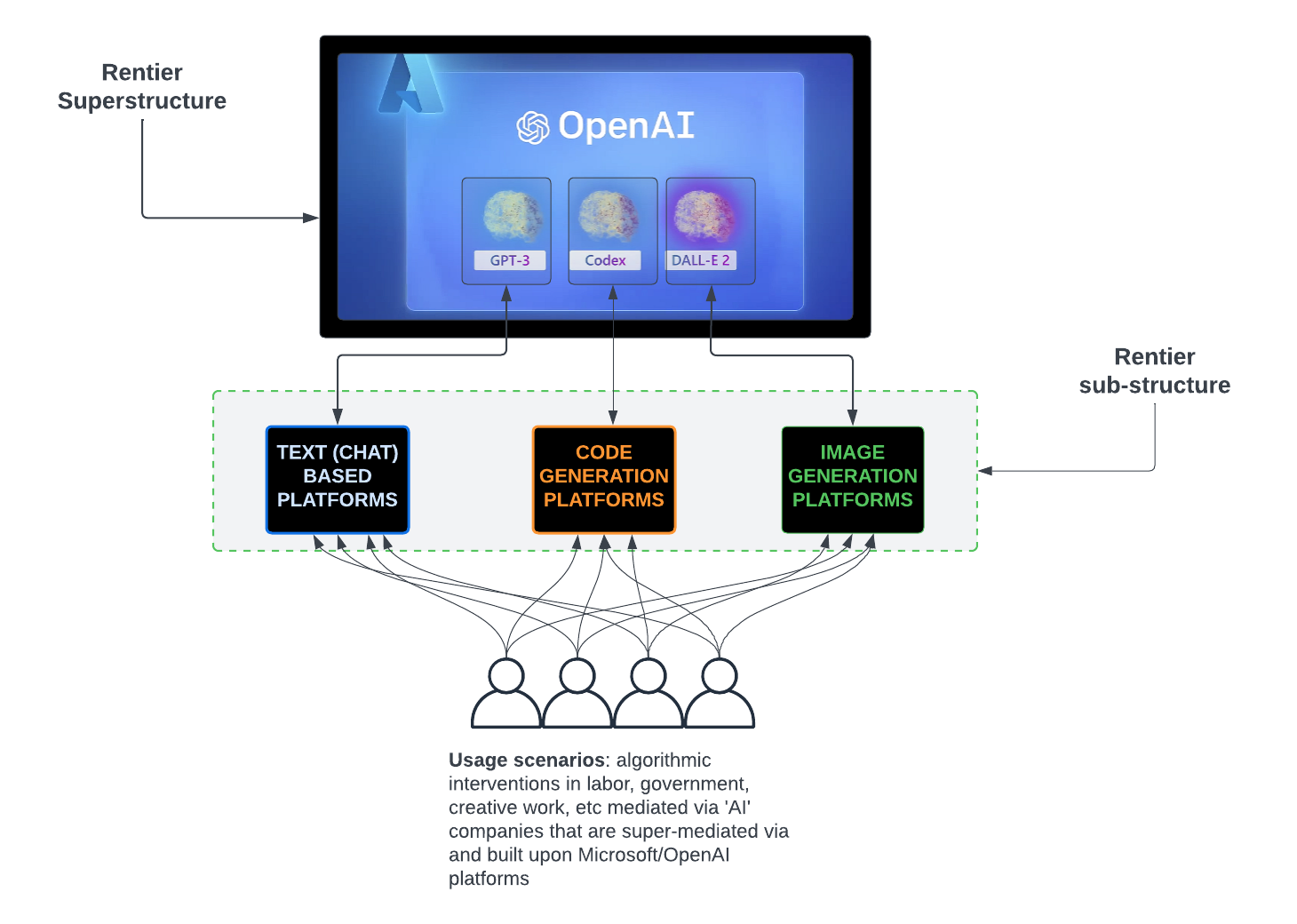
As I watched this video, the purpose of all those billions and the hardware it bought became clear to me; Microsoft and its chief competitors, Amazon and an apparently panicked Google (plus, less well known organizations) are seeking to extend the rentier model of cloud computing, which turns computation, storage and database services into a rented utility and recurring revenue source for the cloud firm that maintains the hardware – even for the largest corporate customers – into the ‘AI’ space, creating super rentier platforms which will spawn subordinate, sub-rentier platforms:

Imagine the following…

A San Francisco based startup, let’s give it a terrible name, Talkist, announces it has developed a remarkable, groundbreaking chat application (and by the way, ‘groundbreaking’ is required alongside ‘next generation’) which will enable companies around the world to replace customer service personnel with Talkist’s ‘intelligent’, ‘ethical’ system. Talkist, which only consists of a few people (mostly men) and a stereotypical, ‘visionary’ leader, probably wearing a thousand dollar t-shirt, doesn’t have the capital, or the desire to build the computational infrastructure required to host such a system.

This is where the Azure/OpenAI complex of systems comes to the rescue of our plucky band of well-funded San Franciscans. Instead of diverting precious venture capital into purchasing data center space and the computers to fill it, that money can be poured into creating applications which utilize Microsoft/OpenAI cloud services. Microsoft/OpenAI rent ‘AI’ capabilities to Talkist who in turn, rent ‘AI’ capabilities to other companies who think they can replace people with text generating, pattern matching systems (ironically, OpenAI itself is dependent on exploited labor as the Time Magazine article, “OpenAI Used Kenyan Workers on Less Than $2 Per Hour to Make ChatGPT Less Toxic” shows).

What a time to be alive.

Of course, the uses (and from the perspective of profit-driven organizations, cost savings) don’t end with chatty software. We can imagine magazines and other publications, weary of having to employ troublesome human beings with their demands for salaries, health care and decent lives (The gall! Are there no workhouses? Are there no prisons?) rushing to use these systems to ‘write’ – or perhaps we should say, mechanistically assemble,  articles and news stories, reducing the need for writers who are an annoying class (I wink at you dear reader for I am the opposite of annoying – being a delightful mixture of cologne, Bordeaux and dialectical analysis). Unsurprisingly, and let’s indulge our desire for a bit of the old schadenfreude, amusingly there are problems such as those detailed in the articles “CNET Is Reviewing the Accuracy of All Its AI-Written Articles After Multiple Major Corrections. and, “CNET’s AI Journalist Appears to Have Committed Extensive Plagiarism.”

Of all the empires that have stalked the Earth, the tech imperium is, perhaps, the bullshitiest. The Romans derived their power from myths, yes, but also, roads, aqueducts and organized violence – real things in a real world.  The US empire has its own set of myths, such as a belief that sitting in a car, in traffic, is the pinnacle of freedom and in meritocracy (a notion wielded by the most mediocre minds to explain their comforts). Once again however, real things, such as possessing the world’s reserve currency and the capacity for ultra-violence lurk behind the curtain.

The tech empire, by contrast, is built, using the Monorail maneuver detailed in this Simpsons episode, on false claims prettily presented. It has inserted itself between us and the things we need – information, memories, creativity. The tech industry has hijacked a variety of commons and then rents us access to what should be open. In its ‘AI’ incarnation, the tech industry attempts to replace human reason with computer power, a fool’s errand, which computer scientist Joseph Weizenbaum dissected almost 50 years ago,  but a goal motivated by a desire to increase the rate of profit in an era of creeping stagnation by reducing the need for labor.

Rather than being a refutation of Marx and Engel’s analysis as some, such as Yanis Varoufakis with his ‘cloudalist’ hypothesis bafflingly claim, we are indeed, still very much dealing with the human grinding workings of capitalist logics, wearing a prop, science fiction film costume, claiming to have come in peace.

ChatGPT isn’t a research platform or the herald of a new age of computation; it is the embodiment of the revenue stream dreams of the tech industry, the super-rentier.