Command and Control: Capitalism and Computation

Capitalism, a system as inescapable as breathless news items about Trump, Musk and decay, came into its own during the age of steam power, telegraphs and colonialism (first edition, we’re witnessing the attempted redux), long before the invention of digital computers. The creation of computers, initially, a tool for military purposes (ENIAC, the first programmable digital computer was immediately put to work performing calculations for then still theoretical hydrogen bombs) eventually enabled capitalists, particularly at the commanding heights, to employ what, in military circles is known as command and control at a level of sophistication and intrusiveness previously only dreamed of. 

What is command and control?

Consider this excerpt from the essay, ‘Re-conceptualizing Command and Control‘, released in 2002 for the Canadian military and co-authored by Dr. Ross Pigeau and Carol McCann which provides a succinct definition:

“…controlling involves monitoring, carrying out and adjusting processes that have already been developed. Commanding involves creating new structures and processes (i.e., plans, SOPs, etc.), establishing the conditions for initiating and terminating action, and making unanticipated changes to plans. Most acts, including decision making, involve a sophisticated amalgam of both commanding and controlling.”

Everyone who has worked in a corporate enterprise, the land of key performance indicators (or, KPIs) and other metrics gathered and analyzed to determine profit and loss, and even, in some cases, who lives and dies, understands this definition in their bones; it captures the hierarchical structure of business, which is a form of tyranny (some of these fiefdoms have pleasant break-out rooms, decent coffee and declarations of workers being in a family until, of course, restructuring and endless re-orgs casts ‘family members’ onto the street).

From the birth of the corporate era, companies have pursued operational and logistics control to ensure profit, market share and high valuation. So-called scientific management, created and promoted by mechanical engineer and early managerial consultant Frederick Taylor in the late 19th century, was the first dedicated effort of the industrial era. Sears and Roebuck, a 19th century retail and mail order behemoth, the Amazon of the pre-digital computer age, employed an army of people, scientifically managed, to run its vast enterprise. There are commonalities between the Sears of old and Amazon:

Sears and Amazon Commonalities: Diagram by Author

The primary difference between Sears in the 19th century and Amazon today is the latter’s use of digital technology to enhance command and control techniques, enhancements that make it possible for Amazon to surveil delivery drivers on their routes, among other outrages.

From Brighter than a Thousand Suns to the Office Commute

Digital computation’s first assignment was performing the subtle calculations physicists such as Edward Teller and Stanislaw Ulam needed to bring the thermonuclear devices of their fevered dreams to irradiated life. From that beginning, brighter than a thousand suns, the age of command and control fully took shape with the creation of systems such as the US Air Force’s Semi-Automatic Ground Environment (SAGE) described in a Wikipedia article:

“The Semi-Automatic Ground Environment (SAGE) was a system of large computers and associated networking equipment that coordinated data from many radar sites and processed it to produce a single unified image of the airspace over a wide area. SAGE directed and controlled the NORAD response to a possible Soviet air attack, operating in this role from the late 1950s into the 1980s.”

SAGE System Console: Wikipedia

The SAGE system was built to create a method and infrastructure for gathering data from far flung sources and coordinating a response to what its numerous displays told people in Strategic Air Command facilities. This military purpose provided the foundation, metaphor and philosophy shaping the uses of systems that eventually came online such as commercial mainframe computers, client server architectures and what is known as ‘cloud computing.’

Note this image of SAGE system elements:

SAGE Diagram: Defense Visual Information Distribution Service

In design intent and philosophy, there is a link between the vision of computation as a means of commanding people and controlling events that shaped the SAGE system and corporate methods such as business intelligence described in this Wikipedia article:

“Business intelligence (BI) consists of strategies, methodologies, and technologies used by enterprises for data analysis and management of business information. Common functions of BI technologies include reporting, online analytical processing, analytics, dashboard development, data mining, process mining, complex event processing, business performance management, bench marking, text mining, predictive analytics, and prescriptive analytics.”

Microsoft, never one to miss an opportunity to simultaneously shape and profit from business requirements, real or imagined (does anyone recall the Metaverse? It disappeared, like youth, or money from your bank account) provides a visual of how a business intelligence platform can be built on their Azure platform:

Azure Business Intelligence Architecture: Microsoft

The common goal – the thematic bridge from SAGE to business intelligence – is data gathering and analysis which, as an objective in abstract, is not at all sinister. Every society and every social organization, no matter how large or small, needs to understand its environment, collect information and act upon what is learned. Just as SAGE applied that methodology to the task of nuclear war (which, outside of the insane circles running the world to ruin, is no one’s idea of a good use case) corporations apply it to maximizing profit. In the capitalist world, we are data points to be ingested, analyzed and optimized via something called KPIs.

Key Performance Indicators – the SAGE of Corporate Life

Key Performance Indicators or, KPIs, are the metric used to include our behavior and actions as workers, into a command and control schema. What, in the past, was directed without the aid of software (Taylorism being the first, formalized example of a pre software method) is now measured as data points stored in databases and spreadsheets. How ‘productive’ are you? KPIs, we’re told, are a way to ensure workers are on track from the perspective of owners. In a 2021 article titled ‘Why You Need Personal KPIs To Achieve Your Goals’, Forbes, a magazine once treated as scripture, advised ‘professionals’ (a word used to lobotomise that portion of one’s mind that is aware of your status as a precarious worker) to use KPIs to shape their careers:

“Peter Drucker famously said that “what is measured is managed, and what is managed gets improved.” Key Performance Indicators (KPI) are a staple of every business. It is the tool used to measure how effectively an organization is meeting vital business objectives. Teams, departments, and organizations initiate the KPIs so that it spreads to every level of an institution. If it’s such a prominent accountability measure in the business sector, why not use it for our professional success? Perhaps we should inculcate personal KPIs into our practice.”

This is good advice in a way not unlike the sort of contextually useful counsel you’d get on how to handle yourself in a bar fight or dealing with a cop who’s obsessed with demonstrating his authority; you contort yourself to survive. It’s useful, but its utility is a sign of a problem, of a system of artificially enforced limits whose boundaries serve others’ interests.

In his 2018 book, ‘Surveillance Valley’, journalist Yasha Levine details the links between the US’ intelligence agencies and Silicon Valley. From the beginning, Levine shows, companies such as Oracle and technologies we think sprung into existence on the sun blasted terrain of California like dreams were nurtured and even created by the US’ surveillance apparatus.

There is a similar link between the techniques used by the corporations who dominate our lives and the systems and thinking which shaped the US’ command and control fixated response to the Cold War. Our work lives exist in the long shadow of the computers used to determine if ICBMs should wing their way to targets.

The F-35 Maneuver

Bad ideas, like death, are inevitable and just as inescapable.

The US-based tech industry is a Pandora’s box of bad ideas, unleashed upon an unwilling and unwitting populace, and indeed world, with reckless abandon, scorching lives and the Earth itself. Never mind, they say, we’re building the future.

The latest bad idea to spread dark wings and take flight is that building a super massive data center for ‘AI’ called ‘Stargate’- a megamachine that will solve all our problems like a resource and real estate devouring Wizard of Oz – is not only good, but essential.

In an Associated Press article titled, ‘Trump highlights partnership investing $500 billion in AI‘ published Jan 23, 2025, the project is described:

WASHINGTON (AP) — President Donald Trump on Tuesday talked up a joint venture investing up to $500 billion for infrastructure tied to artificial intelligence by a new partnership formed by OpenAI, Oracle and SoftBank.

The new entity, Stargate, will start building out data centers and the electricity generation needed for the further development of the fast-evolving AI in Texas, according to the White House. The initial investment is expected to be $100 billion and could reach five times that sum.

“It’s big money and high quality people,” said Trump, adding that it’s “a resounding declaration of confidence in America’s potential” under his new administration.

[…]

It seems like only yesterday, or more precisely, several months ago, that the same ‘Stargate’, with a still astronomically large but comparatively smaller budget, was described in a Tom’s Hardware article of March 24, 2024 titled ‘OpenAI and Microsoft reportedly planning $100 billion datacenter project for an AI supercomputer‘ –

Microsoft and OpenAI are reportedly working on a massive datacenter to house an AI-focused supercomputer featuring millions of GPUs. The Information reports that the project could cost “in excess of $115 billion” and that the supercomputer, currently dubbed “Stargate” inside OpenAI, would be U.S.-based. 

The report says that Microsoft would foot the bill for the datacenter, which could be “100 times more costly” than some of the biggest operating centers today. Stargate would be the largest in a string of datacenter projects the two companies hope to build in the next six years, and executives hope to have it running by 2028.

[…]

Bad ideas are inevitable but also, apparently, subject to cost overruns.

There are many ways to think and talk about this project, which is certain to fail (and there is news of far less costly methods, making the Olympian spending even more obviously suspicious). For me, the clearest way to understand the Stargate project and in fact, the entire ‘AI’ land grab, is as an attempt to create guaranteed profit for those tech firms who’re at the commanding heights – Microsoft, OpenAI, Amazon, Oracle and co-conspirators. Capital will flow into these firms whether the system works as advertised or not – i.e. they are paid for both function (such as it is) and malfunction.

This isn’t a new technique. The US defense industry has a long history of stuffing its coffers with cash for delivering weapons systems that work… sometimes. The most infamous example is Lockheed’s F-35 fighter, a project that provides the company with funding for both delivery and correction as described in the US Government Accounting Office article, ‘F-35 Joint Strike Fighter: More Actions Needed to Explain Cost Growth and Support Engine Modernization Decision’ May 2023 –

The Department of Defense’s most expensive weapon system—the F-35 aircraft—is now more than a decade behind schedule and $183 billion over original cost estimates.

[…]

That’s a decade and 183 billion of sweet, steady profit, the sort of profit the tech industry has long sought. First there was ‘enterprise software’, then there was subscription-based cloud, both efforts to create ‘growth’ and dependable cash infusions. Now, with Stargate, the industry may have, at last, found its F-35. Unlike the troubled fighter plane, there won’t be any Tom Cruise films featuring the data center. Then again, perhaps there will be. Netflix, like the rest of the industry, is out of ideas.

State of Exception – Part Two: Assume Breach

In part one of this series, I proposed that Trump’s second term, which, as we’re seeing with the rush of executive orders, has, unlike his first, a coherent agenda (centered on the Heritage Foundation’s Project 2025 plan), would be a time of increased aggression against ostracized individuals and groups, a state of exception in which the pretence of bourgeois democracy melts away.

Because of this, we should change our relationship with the technologies we’re compelled to use; a naive belief in the good will or benign neglect of tech corporations and the state should be abandoned. The correct perspective is to assume breach.

In a April, 2023 published blog post for the network equipment company, F5, systems security expert Ken Arora, described the concept of assume breach: 

Plumbers, electricians, and other professionals who operate in the physical world have long internalized the true essence of “assume breach.” Because they are tasked with creating solutions that must be robust in tangible environments, they implicitly accept and incorporate the simple fact that failures occur within the scope of their work. They also understand that failures are not an indictment of their skills, nor a reason to forgo their services. Rather, it is only the most skilled who, understanding that their creations will eventually fail, incorporate learnings from past failures and are able to anticipate likely future failures.

[…]

For the purposes of this essay, the term, failure, is re-interpreted to mean the intrusion of hostile entities into the systems and devices you use. By adopting a technology praxis based on assumed breach, you can plan for intrusion by acknowledging the possibility that your systems have, or will be penetrated.

Primarily, there are five areas of concern:

  • Phones
  • Social Media
  • Personal computers
  • Workplace platforms, such as Microsoft 365 and Google’s G-Suite
  • Cloud’ platforms, such as Microsoft Azure, Amazon AWS and Google Cloud Platform

It’s reasonable to think that following security best practices for each technology (links in the references section) offers a degree of protection from intrusion. Although this may be true to some extent, when contending with non-state hostiles, such as black hat hackers, state entities have direct access to the ownership of these systems, giving them the ability to circumvent standard security measures via the exercise of political power.

Phones (and tablets)

Phones are surveillance devices. No communications that require security and which, if intercepted, could lead to state harassment or worse should be done via phones. This applies to iPhones, Android phones and even niche devices such as Linux phones. Phones are a threat in two ways:

  1.  Location tracking – phones connect to cellular networks and utilize unique identifiers that enable location and geospatial tracking. This data is used to create maps of activity and associations (a technique the IDF has used in its genocidal wars)
  2.  Data seizure – phones store data that, if seized by hostiles, can be used against you and your organization. Social media account data, notes, contacts and other information

Phone use must be avoided for secure communications. If you must use a phone for your activist work, consider adopting a secure Linux-based phone such as GrapheneOS which may be more resistant to cracking if seized but not to communication interception. As an alternative, consider using old school methods, such as paper messages conveyed via trusted courier within your group. This sounds extreme and may turn out to be unnecessary depending on how conditions mutate. It is best however, to be prepared should it become necessary.

Social Media

Social media platforms such as Twitter/X, Bluesky, Mastodon, Facebook/Meta and even less public systems such as Discord, which enables the creation of privately managed servers, should not be used for secure communication. Not only because of posts, but because direct messages are vulnerable to surveillance and can be used to obtain pattern and association data. A comparatively secure (though not foolproof) alternative is the use of the Signal messaging platform.  (Scratch that: Yasha Levine provides a full explantation of Signal as a government op here).

Personal Computers

Like phones, personal computers -laptops and Desktops – should not be considered secure. There are several sub-categories of vulnerability:

  • Vulnerabilities caused by security flaws in the operating system (for example, issues with Microsoft Windows or Apple MacOS)
  • Vulnerabilities designed into the operating systems by the companies developing, deploying and selling them for profit objectives (Windows CoPilot, is a known threat vector, for example)
  • Vulnerabilities exploited by state actors such as intelligence and law enforcement agencies (deliberate backdoors)
  • Data exposure if a computer is seized

Operating systems are the main threat vector – that is, opening to your data – when using a computer. In part one of this series, I suggested abandoning the use of Microsoft Windows, Google Chrome OS and Apple’s Mac OS for computer usage that requires security and using secure Debian Linux instead. This is covered in detail in part one.

Workplace Platforms such as Google G-Suite and Microsoft 365 and other ‘cloud’ platforms such Microsoft Azure and Amazon Web Services

Although convenient, and, in the case of Software as a Service offerings such as Google G-Suite and Microsoft 365, less technically demanding to manage than on-premises hosting, ‘cloud’ platforms should not be considered trustworthy for secure data storage or communications.

This is true, even when platform-specific security best practices are followed because such measures will be circumvented by the corporations that own these platforms when it suits their purposes – such as cooperating with state mandates to release customer data.

The challenge for organizations who’re concerned about state sanctioned breach is finding the equipment, technical talent, will and organizational skill (project management) to move away from these ‘cloud’ systems to on-premises platforms. This is not trivial and has so many complexities that it deserves a separate essay, which will be part three of this series.

The primary challenges are:

  • Inventorying the applications you use
  • Assessing where the organisation’s data is stored and the types of data
  • Assessing the types of communications and the levels of vulnerability (for example, how is email used? What about collaboration services such as SharePoint?)
  • Crafting an achievable strategy for moving applications, services and data off the vulnerable cloud service
  • Encrypting and deleting data

In part three of this series, I will describe moving your organisation’s data and applications off of cloud platforms: what are the challenges? What are the methods? What skills are required? I’ll talk about this and more.

References

Assume Breach

Project 2025

Security Best Practices – Google Workspace

Microsoft 365 Security Best Practices

Questions and Answers: Israeli Military’s Use of Digital Tools in Gaza

UK police raid home, seize devices of EI’s Asa Winstanley

Cellphone surveillance

GrapheneOS

Meta-provided Facebook chats led a woman to plead guilty to abortion-related charges

State of Exception: Part One

In his 2005 published book, State of Exception, Italian philosopher Giorgio Agamben (who, I feel moved to say, was an idiot on the topic of Covid 19, declaring the virus to be nonexistent) wrote:

The state of exception is the political point at which the juridical stops, and a sovereign unaccountability begins; it is where the dam of individual liberties breaks and a society is flooded with the sovereign power of the state.”

The (apparently, merely delayed by four years) re-election of Donald Trump is certain to usher in a sustained period of domestic emergency in the United States, a state of exception when even the pretense of bourgeois democracy is dropped and state power is exercised with few restraints.

What does this mean for information technology usage by activist groups or really, anyone?

In Feb of 2024, I published the essay, Information Technology for Activists – What is To Be Done? In this essay, I provided an overview of the current information technology landscape, with the needs and requirements of activist groups in mind. When conditions change, our understanding should keep pace. As we enter the state of exception, the information technology practices of groups who can expect harassment, or worse, from the US state should be radically updated for a more aggressively defensive posture.

Abandon Cloud

The computer and software technology industry is the command and control apparatus of corporate and state entities. As such, its products and services should be considered enemy territory. Under the capitalist system, we are compelled to operate on this territory to live. This harsh necessity should not be confused with acceptance and is certainly not a reason to celebrate, like dupes, the system that is killing the world. 

The use of operating systems and platforms from the tech industry’s primary powers – Microsoft, Amazon, Google, Meta, X/Twitter, Apple, Oracle – and lesser known entities, creates a threat vector through which identities, data and activities can be tracked and recorded. Moving off these platforms will be very difficult but is essential. What are the alternatives? 

There are three main areas of concern:

  • Services and platforms such as social media, cloud and related services
  • Personal computers (for example, laptops)
  • Phones

In this essay, cloud and computer usage are the focus.

By ‘cloud’, I’m referring to the platforms owned by Microsoft (Azure), Amazon (Amazon Web Services or, AWS) and Google (Google Cloud Platform or GCP) and services such as Microsoft 365 and Google’s G Suite. These services are not secure for the purposes of activist groups and individuals who can expect heightened surveillance and harassment from the state.  There are technical reasons (Azure, for example, is known for various vulnerabilities) but these are of a distant, secondary concern to the fact that, regardless of each platform’s infrastructural qualities or deficits, the corporations owning them are elements of the state apparatus.

Your data and communications are not secure. If you are using these platforms, your top priority should be abandoning usage and moving your computational resources to what are called on-premises facilities and use the Linux operating system, rather than MacOS or Microsoft Windows.  

On Computers

In brief, operating systems are a specialized type of software that makes computers useful. When you open Microsoft Excel on your computer, it’s the Microsoft Windows operating system that enables the Excel program to utilize computer hardware, such as memory and storage. You can learn more about operating systems by reading this Wikipedia article. This relationship – between software and computing machinery – applies to all the systems you use: whether it’s Windows, Mac or others.

Microsoft Windows (particularly the newest versions which include the insecure by design ‘Co-pilot plus PC’ feature) and Apple’s MacOS should be abandoned. Why? The tech industry, as outlined in Yasha Levine’s book, Surveillance Valley, works hand in glove with the surveillance state (and has done so since the industry’s infancy). If you or your organization are using computers for work that challenges the US state – for example, pro-Palestinian activism or indeed, work in support of any marginalized community, there is a possibility vital information will be compromised – either through seizure, or remote access that takes advantage of backdoors and vulnerabilities.

This was always a possibility (and for some, a harsh experience) but as the state’s apparatus is directed towards coordinated, targeted suppression, vague possibility turns into high probability (see, for example, UK police raid home, seize devices of EI’s Asa Winstanley).

The Linux operating system should be used instead, specifically, the Debian distribution, well known for its secure design. Secure by design does not mean invulnerable to attack; best practices such as those described in the article, Securing Debian Manual 3.19, on the Debian website, must be followed to make a machine a harder target.

Switching and Migration

Switching from Microsoft Windows to Debian Linux can be done in stages as described in the document ‘From Windows to Debian’. Replacing MacOS with Debian on Mac Pro computers is described in the document, ‘Macbook Pro’ on the Debian website. More recent Mac hardware (M1 Silicon) is being addressed via Debian’s Project Banana.

On software

If you’re using Microsoft Windows, it’s likely you’re also using the MS Office suite. You may also be using Microsoft’s cloud ‘productivity’ platform, Microsoft 365. Perhaps you’re using Google’s Workspace platform instead or in addition to Microsoft 365. In the section on ‘Services and Platforms’, I discuss the problems of these products from a security perspective. For now, let’s review replacements for commercial ‘productivity’ suites that are used to create documents, spreadsheets and other types of work files.


In the second installment of this essay series I will provide greater detail regarding each of the topics discussed and guidance about the use of phones which are spy devices and social media, which is insecure by design.

AI as Stagnation: On Tech Imperialism

Unless you’ve been under a rock, and probably, even if you have, you’ve noticed that ‘AI’ is being promoted as the solution to everything from climate change to making tacos. There’s an old joke: how do you know when a politician is lying? Their mouth is moving. Similarly, anytime businesses relentlessly push something, the first question that should come to mind is: how are they trying to make money?

Microsoft, in particular, has, as the saying goes, gone all in rebranding its implementation of OpenAI’s ChatGPT large language model based products as CoPilot, embedded across Microsoft’s catalog. Leaving aside, for the sake of this essay, the question of what so-called AI actually is, (hint: statistics)  considering this push, it’s reasonable to ask: what is going on?

Ideology certainly plays a role

That is, the belief (or at least, the assertion) of a loud segment of the tech industry that they are building Artificial General Intelligence – a successor to humanity, genuinely thinking machines

Ideology is an important factor but it’s more useful to place technology firms such as Microsoft back within capitalism in our thinking. This is a way to reject the diversions this sector uses to obscure that fact

To do this, let’s consider Vladimir Lenin’s theory of imperialism as expressed in his essay, ‘Imperialism the highest stage of capitalism’.

In January of 2023, I published an essay to my blog titled, ChatGPT: Super Rentier.

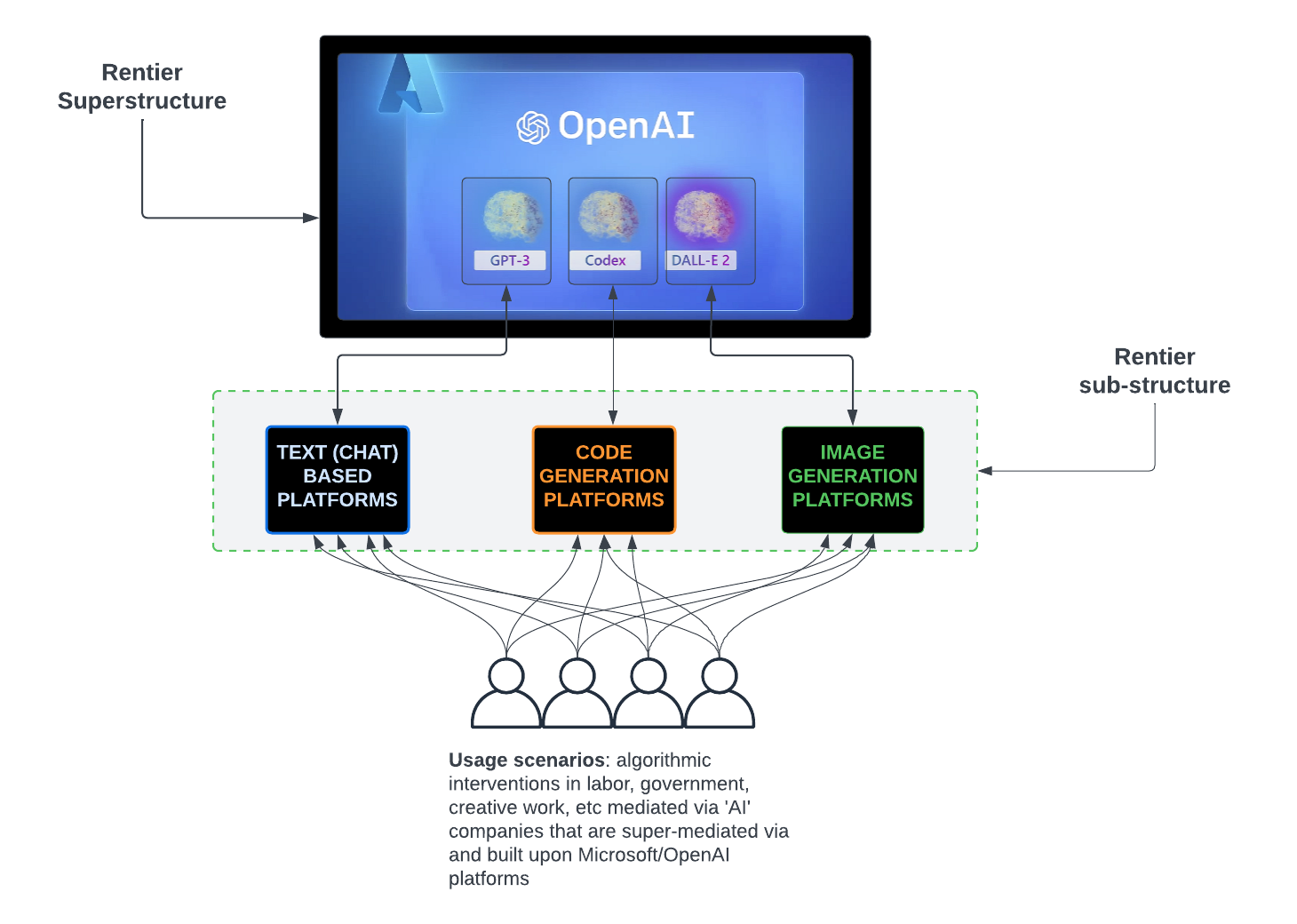
The thesis of that essay is that Microsoft’s partnership with, and investment in, OpenAI and the insertion of OpenAI’s large language model software, known as ChatGPT into Microsoft’s product catalog, was done to create a platform Microsoft would use to make it a kind of super rentier – or, super landlord – of AI systems. Others, sub-rentiers, would build their platforms using Microsoft’s platform as the backend making it the super rentier – the landlord of landlords.

With this in mind, let’s take a look at this visualization of Lenin’s concept of imperialism I cooked up:

For me, the key element is the relationship between the tendency towards monopoly which leads to stagnation (after all, what’s the incentive to stay sharp if you control a market?) and the expansion of capitalist activity to other, weaker territories to temporarily resolve this stagnation – this is the material motive for capitalist imperialism or as Lenin also phrased it, parasitism.

Let’s apply this theory to Microsoft and its push for AI everywhere:

Microsoft, as a software firm, once derived most of its profit from selling products such as SQL Server, Exchange Server and the Office Suite. 

This became a near monopoly for Microsoft as it dominated the corporate market for these and other types of what’s known as enterprise applications. 

This monopoly led to stagnation – how many different ways can you try to derive profit from Microsoft Office, for example? By stagnation, I don’t mean that Microsoft did not make money or profit from its dominance, but this dominance no longer supported the growth capitalists demand.

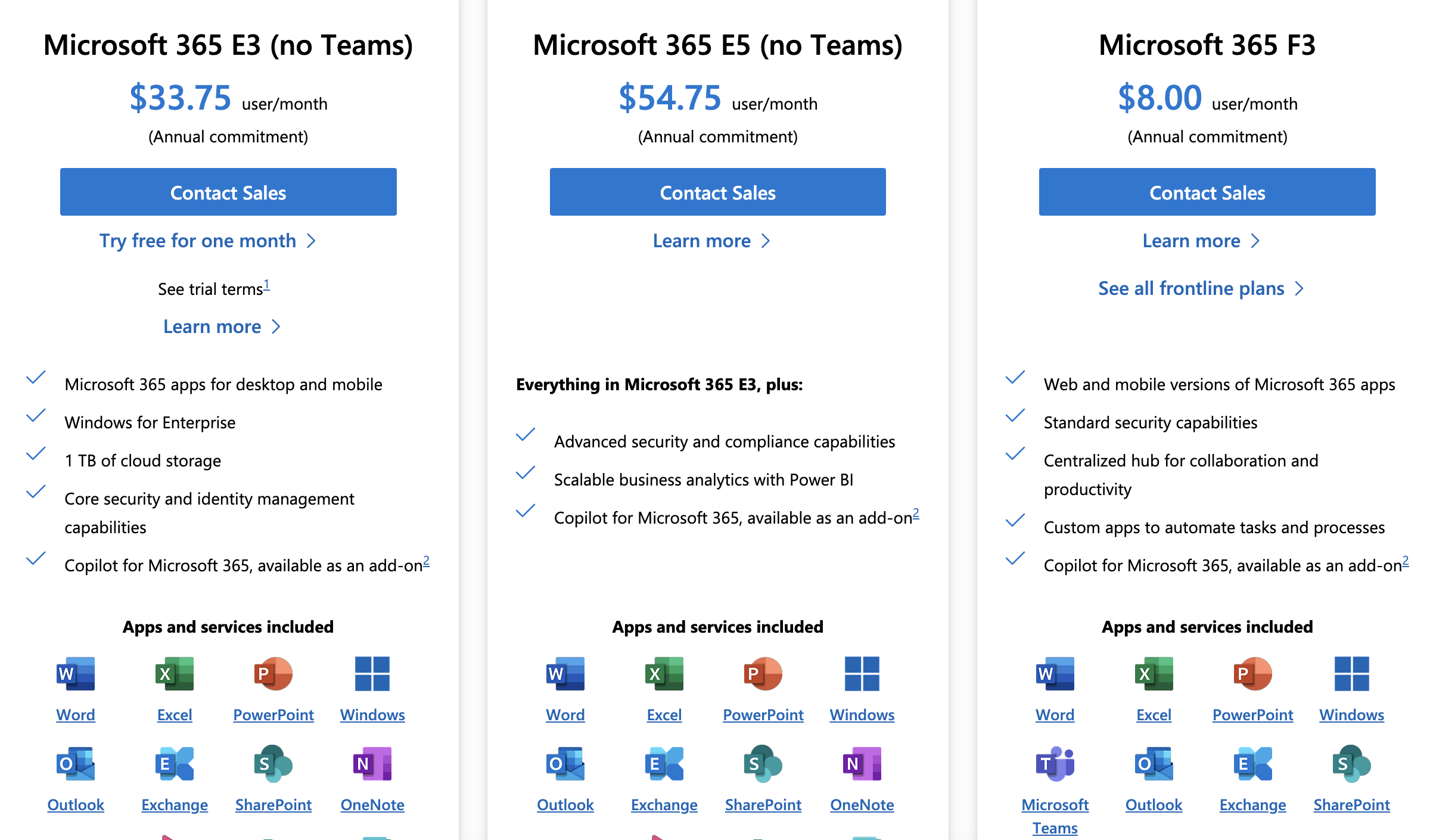
The answer, for a time, was the subscription model of the Microsoft 365 platform which moved corporations from a model in which products such as Exchange would be hosted in-house in corporate data centers and licensed, to one in which there was a recurring charge for access and guaranteed revenue stream for Microsoft.

No longer was it possible for a company to buy a copy of a product and use it even after licensing expired. Now, you have to pay up, routinely, to maintain access.

After a time, even this led to a near monopoly and the return of stagnation as the market for expansion was saturated

Into this situation, enter ‘AI’

By inserting AI – chatbots and image generators into every product and pushing for this to be used by its corporate customers, Microsoft is enacting a form of the imperialist expansion Lenin described – it is a colonization of business process, education, art, filmmaking science and more on an unprecedented scale

But what haunts the AI push is the very stagnation it is supposed to remedy

There is no escape from the stagnation caused by monopoly, only temporary fixes which merely serve to create the conditions for future decay and conflict.

References

ChatGPT

Microsoft Copilot

Imperialism the highest stage of capitalism by VI Lenin

ChatGPT – Super Rentier

All Roads Lead to Surveillance Valley (on Windows 11 Recall)

Microsoft’s recent announcement of a product named Recall for Copilot Plus PCs, which reportedly features built-in ‘AI’ hosted on a ‘Neural Processing Unit’, provides us with an opportunity to take a look at the political economy of the technology industry in the era of decline.

I say ‘decline’, because Recall, despite the hosannas we’re hearing from the tech press – Silicon Valley’s Pravda – does not represent an advance but a rearguard move to accomplish what I see as two goals: 

  1. Increase and guarantee Microsoft’s ‘AI’ related revenue stream by using its dominance of the PC operating system market (both consumer and corporate) to force a failing product on customers (Tesla’s so-called full self driving software provides another example)
  2. Increase ‘AI’ related revenue by marketing Recall as a surveillance tool to governments and corporations

On point one: Despite a massive investment in OpenAI, including hosting and operating Azure data centers for the ChatGPT suite of resource destroying text calculators and embedding the large language model in flagship products Azure and Microsoft 365, it’s not clear Microsoft (or any company) has seen a return on its ‘AI’ investment. Quite the contrary. Recall creates a compelled revenue stream as corporations refresh their fleets of laptops. Microsoft has tried to recoup costs via high prices for products such as Github Copilot but this does not seem to be working as hoped; organizations can opt out. 

On point two: In a Wall Street Journal interview, Microsoft CEO Satya Nadella described Recall’s capabilities as a “photographic memory” that is, recording every image and action on a PC, using an onboard neural processing unit to run this data (supposedly kept on the machine) through a model or models to enable more sophisticated, ‘AI’ enabled searching. 

This seems like a lot of engineering effort to make it easier to find a photo you took at the beach a few years ago. Corporations don’t care about making anyone’s life easier so we must look for more adult, power-aware explanations for what we’re seeing here. 

Consider the precedent of Windows Vista, released in 2006. Vista, which employed a complex method for enforcing corporate digital rights, was created by Microsoft to attract the attention of the film and music industries as the preferred way to exert command and control over our use of ‘content’.  With Vista, Microsoft’s goal was to become the gatekeeper for the digital distribution of entertainment and derive profit from that position. This didn’t work out as planned but the effort is a key indicator of intent. I interpret Recall as being the ‘AI’ variant of the gatekeeper gambit.

We can safely ignore happy talk and promises of privacy to see what is right before us: a system for recording everything you do will be marketed to businesses and governments as a means of mass surveillance. What was once the description of malware has, in the age of ‘AI’ become a product. In its quest for profits, Microsoft is creating a difficult to escape, hardware based, globally distributed monitoring platform. We can be certain that its competitors, such as Apple, are making similar moves.

***

When thinking about the tech industry and its endless stream of product announcements, particularly about ‘AI’, a good rule of thumb is to ignore whatever glittering words are used to ask one question: how do they plan to make money? But not just ‘money’ in the abstract, profit. Looking at Recall for Windows 11, a follow the money approach leads directly to what Yasha Levine called ‘Surveillance Valley’.


References

Recall is Microsoft’s key to unlocking the future of PCs The Verge

ChatGPT costs $700,000 per day to run, which is why Microsoft wants to make its own AI chipsWindows Central

OpenAI and Microsoft Plan $100 Billion ‘Stargate’ Data Center in the U.S.Enterprise AI

A Cost Analysis of Windows Vista Content ProtectionPeter Gutmann

Surveillance Valley Yasha Levine

Information Technology for Activists – What is To Be Done?

Introduction

This is written in the spirit of the Request for Comments memorandums that shaped the early Internet. RFCs, as they are known, are submitted to propose a technology or methodology and gather comments/corrections from relevant and knowledgeable community members in the hope of becoming a widely accepted standard.

Purpose

This is a consideration of the information technology options for politically and socially active organizations. It’s also a high level overview of the technical landscape. The target audience is technical decision makers in groups whose political commitments challenge the prevailing order, focused on liberation. In this document, I will provide a brief history of past patterns and compare these to current choices, identifying the problems of various models and potential opportunities.

Alongside this blog post there is a living document posted for collaboration here. I invite a discussion of ideas, methods and technologies I may have missed or might be unaware of to improve accuracy and usefulness.

Being Intentional About Technology Choices

It is a truism that modern organizations require technology services. Less commonly discussed are the political, operational, cost and security implications of this dependence from the perspective of activists. It’s important to be intentional about technological choices and deployments with these and other factors in mind. The path of least resistance, such as choosing Microsoft 365 for collaboration rather than building on-premises systems, may be the best, or least terrible choice for an organization but the decision to use it should come after weighing the pros and cons of other options. What follows is not an exhaustive history; I am purposefully leaving out many granular details to get to the point as efficiently as possible.

A Brief History of Organizational Computing

By ‘organizational computing’ I’m referring to the use of digital computers arranged into service platforms by non-governmental and non-military organizations. In this section, there is a high level walk through of the patterns which have been utilized in this sector.

Mainframes

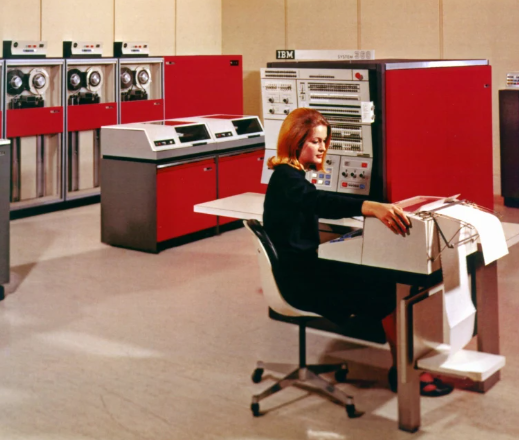
IBM 360 in Computer Room – mid 1960s

The first use of digital computing at-scale was the deployment of mainframe systems as centrally hosted resources. User access, limited to specialists, was provided via a time sharing method in which ‘dumb’ terminals displayed results of programs and enabled input (punch cards were also used for inputting program instructions). One of the most successful systems was the IBM 360 (operational from 1965 to 1978). Due to expense, the typical customer was large banks, universities and other organizations with deep pockets.

Client Server

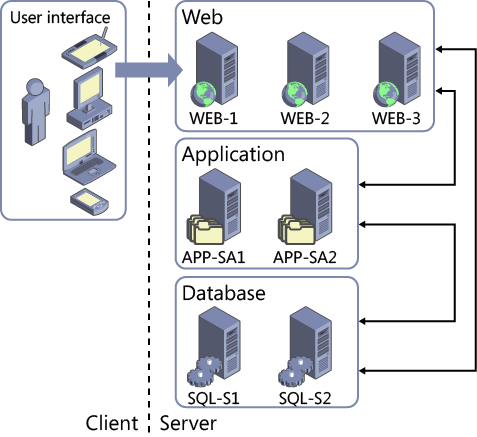
Classic Client Server Architecture (Microsoft)

The introduction of personal computers in the 1980s created the raw material for the development of networked, smaller scale systems that could supplement mainframes and provide organizations with the ability to host relatively modest computing platforms that suited their requirements. By the 1990s, this became the dominant model used by organizations at all scales (mainframes remain in service but the usage profile became narrower – for example, to run applications requiring greater processing capability than what’s possible using PC servers).

The client server model era spawned a variety of software applications to meet organizational needs such as email servers (for example, Sendmail and Microsoft Exchange), database servers (for ex. Postgres and SQL Server), web servers such as Apache and so on. Companies such as Novell, Cisco, Dell and Microsoft rose to prominence during this time.

As the client server era matured and the need for computing power grew, companies like VMWare sold platforms that enabled the creation of virtual machines (software mimics of physical servers). Organizations that could not afford to own or rent large data centers could deploy the equivalent of hundreds or thousands of servers within a smaller number of more powerful (in terms of processing capacity and memory) computing systems running VMWare’s ESX software platform. Of course, the irony of this return to something like a mainframe was not lost on information technology workers whose careers spanned the mainframe to client server era.

Cloud computing

Cloud Pattern (Amazon Web Services)

Virtualization, combined with the improved Internet access of the early 2000s, gave rise to what is now called ‘cloud.’ Among information technology workers, it was popular to say ‘there is no cloud, it’s just someone else’s computer.’ Overconfident cloud enthusiasts considered this to be the complaint of a fading old guard but it is undeniably true.

The Cloud Model

There are four modes of cloud computing:

  • Infrastructure as a service – IaaS: (for example, building virtual machines on platforms such as Microsoft Azure, Amazon Web Services or Google Cloud Platform)
  • Platform as a service – PaaS:  (for example, databases offered as a service utility eliminating the need to create a server as host)
  • Software as a Service – SaaS: (platforms like Microsoft 365 fall into this category)
  • Function as a Service – FaaS:  (focused on deployment using software development – ‘code’ – alone with no infrastructural management responsibilities)

A combination of perceived (but rarely realized) convenience, marketing hype and mostly unfulfilled promises of lower running costs have made the cloud model the dominant mode of the 2020s. In the 1990s and early 2000s, an organization requiring an email system was compelled to acquire hardware and software to configure and host their own platform (the Microsoft Exchange email system running on Dell server or VMWare hardware was a common pattern). The availability of Office 365 (later, Microsoft 365) and Google’s G-Suite provided another, attractive option that eliminated the need to manage systems while providing the email function.

A Review of Current Options for Organizations

Although tech industry marketing presents new developments as replacing old, all of the pre-cloud patterns mentioned above still exist. The question is, what makes sense for your organization from the perspectives of:

  • Cost
  • Operational complexity
  • Maintenance complexity
  • Security and exposure to vulnerabilities
  • Availability of skilled workers (related to the ability to effectively manage all of the above)

We needn’t include mainframes in this section since they are cost prohibitive and today, intended for specialized, high performance applications.

Client Server (on-premises)

By ‘on-premises’ we are referring to systems that are not cloud-based. Before the cloud era, the client server model was the dominant pattern for organizations of all sizes. Servers can be hosted within a data center the organization owns or within rented space in a colocation facility (a business that provides rented space for the servers of various clients).

Using a client server model requires employing staff who can install, configure and maintain systems. These skills were once common, indeed standard, and salaries were within the reach of many mid-size organizations. The cloud era has made these skills harder to come by (although there are still many skilled and enthusiastic practitioners). A key question is, how much investment does your organization want to make in the time and effort required to build and manage its own system? Additional questions for consideration come from software licensing and software and hardware maintenance cycles.

Sub-categories of client server to consider

Virtualization and Hyper-converged hardware

As mentioned above, the use of virtualization systems, offered by companies such as VMWare, was one method that arose during the heyday of client server to address the need for more concentrated computing power in a smaller data center footprint.

Hyper-converged infrastructure (HCI) systems, combining compute, storage and networking into a single hardware chassis, is a further development of this method. HCI systems and virtualization reduce the required operational overhead. More about this later.

Hybrid architectures

A hybrid architecture uses a mixture of on-premises and off-site, typically ‘cloud’ based systems. For example, an organization’s data might be stored on-site but the applications using that data are hosted by a cloud provider.

Cloud

Software as a Service

Software as a Service platforms such as Microsoft 365 are the most popular cloud services used by firms of all types and sizes, including activist groups. The reasons are easy to understand:

  • Email services without the need to host an email server
  • Collaboration tools (SharePoint and MS Teams for example) built into the standard licensing schemes
  • Lower (but not zero) operational responsibility
  • Hardware maintenance and uptime are handled by the service provider

The convenience comes at a price, both financial, as licensing costs increase and operational inasmuch as organizations tend to place all of their data and workflows within these platforms, creating deep dependencies.

Build Platforms

The use of ‘build platforms’ like Azure and AWS is more complex than the consumption model of services such as Microsoft 365. Originally, these were designed to meet the needs of organizations that have development and infrastructure teams and host complex applications. More recently, the ‘AI’ hype push has made these platforms trojan horses for pushing hyperscale algorithmic platforms (note, as an example, Microsoft’s investment in and use of OpenAI’s Large Language Model kit) The most common pattern is a replication of large-scale on-premises architectures using virtual machines on a cloud platform. 

Although marketed as superior to, and simpler than on-premises options, cloud platforms require as much, and often more technical expertise. Cost overruns are common; cloud platforms make it easy to deploy new things but each item generates a cost. Even small organizations can create very large bills. Security is another factor; configuration mistakes are common and there are many examples of data breaches produced by error.

Private Cloud

The potential key advantage of the cloud model is the ability to abstract technical complexity. Ideally, programmers are able to create applications that run on hardware without the requirement to manage operating systems (a topic outside of the scope of this document). Private cloud enables the staging of the necessary hardware on-premises. A well known example is Openstack which is very technically challenging. Commercial options include Microsoft’s Azure Stack which extends the Azure technology method to hyper converged infrastructure (HCI) hosted within an organization’s data center.


Information Technology for Activists – What is To Be Done?

In the recent past, the answer was simple: purchase hardware and software and install and configure it with the help of technically adept staff, volunteers or a mix. In the 1990s and early 2000s it was typical for small to midsize organizations to have a collection of networked personal computers connected to a shared printer within an office. Through the network (known as a local area network or LAN) these computers were connected to more powerful computers called servers that provide centralized storage and the means through which each individual computer could communicate in a coordinated manner and share resources.  Organizations often hosted their own websites which were made available to the Internet via connections from telecommunications providers.

Changes in the technology market since the mid 2000s, pushed to increase the market dominance and profits of a small group of firms (primarily, Amazon, Microsoft and Google) have limited options even as these changes appear to offer greater convenience. How can these constraints be navigated?

Proposed Methodology and Doctrines

Earlier in this document, I mentioned the importance of being intentional about technology usage. In this section, more detail is provided.

Let’s divide this into high level operational doctrines and build a proposed architecture from that.

First Doctrine: Data Sovereignty

Organizational data should be stored on-premises using dedicated storage systems rather than in a SaaS such as Microsoft 365 or Google Workspace

Second Doctrine: Bias Towards Hybrid

By ‘hybrid’ I am referring to system architectures that utilize a combination of on-premises and ‘cloud’ assets

Third Doctrine: Bias Towards System Diversity

This might also be called the right tool for the right job doctrine. After consideration of relevant factors (cost, technical ability, etc) an organization may decide to use Microsoft 365 (for example) to provide some services but other options should be explored in the areas of:

  • Document management and related real time collaboration tooling
  • Online Meeting Platforms
  • Database platforms
  • Email platforms

Commercial platforms offer integration methods between platforms that make it possible to create an aggregated solution from disparate tools.

These doctrines can be applied as guidelines for designing an organizational system architecture:

The above is only one option. More are possible depending on the aforementioned factors of:

  • Cost
  • Operational complexity
  • Maintenance complexity
  • Security and exposure to vulnerabilities
  • Availability of skilled workers (related to the ability to effectively manage all of the above)

I invite others to add to this document to improve its content and sharpen the argument.


Activist Documents and Resources Regarding Alternative Methods

Counter Cloud Action Plan – The Institute for Technology In the Public Interest

https://titipi.org/pub/Counter_Cloud_Action_Plan.pdf

Measurement Network

“measurement.network provides non-profit network measurement support to academic researchers”

https://measurement.network

Crisis, Ethics, Reliability & a measurement.network by Tobias Fiebig Max-Planck-Institut für Informatik Saarbrücken, Germany

https://dl.acm.org/doi/pdf/10.1145/3606464.3606483

Tobias Fiebig Max-Planck-Institut für Informatik and Doris Aschenbrenner Aalen University

https://dl.acm.org/doi/pdf/10.1145/3538395.3545312

Decentralized Internet Infrastructure Research Group Session Video

“Oh yes! over-preparing for meetings is my jam :)”:The Gendered Experiences of System Administrators

https://dl.acm.org/doi/pdf/10.1145/3579617

Revolutionary Technology: The Political Economy of Left-Wing Digital Infrastructure by Michael Nolan

https://osf.io/hva2y/


References in the Post

RFC

https://en.wikipedia.org/wiki/Request_for_Comments

Openstack

https://en.wikipedia.org/wiki/OpenStack

Self Hosted Document Management Systems

https://noted.lol/self-hosted-dms-applications/

Overview

https://noted.lol/self-hosted-dms-applications/

Teedy

https://teedy.io/?ref=noted.lol#!/

Only Office

https://www.onlyoffice.com/desktop.aspx

Digital Ocean

https://www.digitalocean.com/

IBM 360 Architecture

https://www.researchgate.net/figure/BM-System-360-architectural-layers_fig2_228974972

Client Server Model

https://en.wikipedia.org/wiki/Client–server_model

Mainframe

https://en.wikipedia.org/wiki/Mainframe_computer

Virtual Machine

https://en.wikipedia.org/wiki/Virtual_machine

Server Colocation

https://www.techopedia.com/definition/29868/server-colocation

What is server virtualization

https://www.techtarget.com/searchitoperations/definition/What-is-server-virtualization-The-ultimate-guide

Letter to an AI Researcher

[In this post, I imagine that I’m writing to a researcher who, disappointed, and perhaps confused by the seemingly unstoppable corporate direction their field is taking, needs a bit of, well, not cheering up precisely but, something to help them understand what it all means and how to resist]

My friend,

Listen, I know you’ve been thrown by the way things have been going for the past few years – really, the past decade; a step by step privatization of the field you love and education pursued at significant financial cost (you’re not a trust funder) because of your desire to understand cognition and just maybe, build systems that, through their cognitive dexterity, aid humanity (vainglorious but, why not aim high?) You thought of people such as McCarthy, Weizenbaum, Minsky and Shannon and hoped to blaze trails, as they did.


When OpenAI hit the scene in 2015, with the promise – in its very name – to be an open home for advanced research, you celebrated. Over wine, we argued (that’s too strong, more like warmly debated with increasing heat as the wine flowed) about the participation of sinister figures such as Musk and Thiel. At the time, Musk was something of a hero to you and Thiel? Well, he was just a quirky VC with deep pockets and an overlooked penchant for ideas that are a bit Goebbels-esque.  “Form follows function,” I said, “and the function of these people is to find ways to generate profit and pretend they’re gods.” But we let that drop over glasses of chardonnay.

Here we are, in 2023… which for you, or more pointedly your dreams, has become an annus horribilis, a horrible year. OpenAI is now married to Microsoft and the much anticipated release of GPT-4 is, in its operational and environmental impact details, shrouded in deliberate mystery. AI ethics teams are discarded like used tissues – there is an air of defeat as the idea of the field you thought you had joined dies the death of a thousand cuts.

Now is the time to look around and remember what I told you all those years ago: science and engineering (and your field contains both these things) do not exist outside of the world but are very much in it and are subject to a reality described by the phrase you’ve heard me say a million times: political economy.  Our political economy – or, I should say, the political economy (the interrelations of law, production, custom and more) we’re subject to, is capitalist. What does this mean for your field?

It means that the marriage between OpenAI and Microsoft,  the integration of large language models with the Azure cloud and the M365 SaaS platforms, the elimination of ethics teams whose work might challenge or impede marketing efforts, the reckless proliferation of algorithmically enacted harms is all because the real goal is profit, which is at the heart of capitalist political economy.

And we needn’t stop with Microsoft; there is no island to run to, no place that is outside of this political economy. No, not even if your team and leadership are quite lovely. This is a totalitarian (or, if you’re uncomfortable with that word, hegemonic) system which covers the globe in its harsh logic.

Oh but now you’re inclined to debate again and it’s too early for wine. I can hear you saying, ‘We can create an ethical AI; it’s possible. We can return to the research effort of years past’ I won’t say it’s impossible, stranger things have presumably happened in the winding history of humanity,  but taking the whole fetid situation into account – yes, the relationship between access to computation and socio-technical power, the political economy, it’s not probable. So long as you continue believing in something that the structure of the society we live in does not support, you will continue to be disappointed. 

Unless, that is, that structure is changed.


What is to be done?

I don’t expect you to become a Marxist (though it would be nice, we could compare obscure notes about historical materialism) but what I’m encouraging you to consider is that the world we grew up in and, quite naturally take for granted as immutable – the world of capitalist social relations, the world which, among other less than fragrant things, has all but completely absorbed your field into its profit engine is not the only way to organize human society.

Once you accept that, we can begin to talk about what might come next.

ChatGPT: Super Rentier

I have avoided writing about ChatGPT as one might hurriedly walk past a group of co-workers, gathered around a box of donuts who’re talking about a popular movie or show; to avoid being drawn into the inevitable.

In some circles, certainly the circles I travel in, ChatGPT is the relentless talk of the town. Everyone from LinkedIn hucksters who claimed to be making millions from the platform, only moments after it was released, to the usual ‘AI’ enthusiasts who take any opportunity to sweatily declare a new era of machine intelligence upon us – and of course, a scattering of people carefully analyzing the actually existing nuts and bolts – everyone seems to be promoting, debating and shouting about ChatGPT.

You can imagine me, dear reader, in the midst of this drama, quietly sitting in a timeworn leather chair, slowly sipping a glass of wine while a stream of text, video and audio, all about ChatGPT, that silicon, would-be Golem, washes over me

What roused me from my torpor was the news Microsoft was investing 10 billion dollars in OpenAI, the organization behind ChatGPT and other ballyhooed large language model systems (see: “Microsoft’s $10bn bet on ChatGPT developer marks new era of AI”). Even for Microsoft, that’s a lot of money. Behind all this, is Microsoft’s significant investment in what it calls purpose built, AI supercomputers such as VOYAGER-EUS2 to train and host platforms such as ChatGPT. Although tender minded naifs believe corporations are using large scale computation to advance humanity, more sober minds are inclined to ask fundamental questions such as, why?

The answer came from the Microsoft article, “General availability of Azure OpenAI Service expands access to large, advanced AI models with added enterprise benefits.” Note that phrase, enterprise benefits.’ The audience for this article is surely techie and techie adjacent (and here, I must raise my hand) but even if neither of these categories describes you I suggest giving it a read.  There’s also an introductory video, providing a walkthrough of using the OpenAI tooling that’s mediated via the Microsoft Azure cloud platform.

Microsoft Video on OpenAI Platforms, Integrated with Azure

As I watched this video, the purpose of all those billions and the hardware it bought became clear to me; Microsoft and its chief competitors, Amazon and an apparently panicked Google (plus, less well known organizations) are seeking to extend the rentier model of cloud computing, which turns computation, storage and database services into a rented utility and recurring revenue source for the cloud firm that maintains the hardware – even for the largest corporate customers – into the ‘AI’ space, creating super rentier platforms which will spawn subordinate, sub-rentier platforms:

Imagine the following…

A San Francisco based startup, let’s give it a terrible name, Talkist, announces it has developed a remarkable, groundbreaking chat application (and by the way, ‘groundbreaking’ is required alongside ‘next generation’) which will enable companies around the world to replace customer service personnel with Talkist’s ‘intelligent’, ‘ethical’ system. Talkist, which only consists of a few people (mostly men) and a stereotypical, ‘visionary’ leader, probably wearing a thousand dollar t-shirt, doesn’t have the capital, or the desire to build the computational infrastructure required to host such a system.

This is where the Azure/OpenAI complex of systems comes to the rescue of our plucky band of well-funded San Franciscans. Instead of diverting precious venture capital into purchasing data center space and the computers to fill it, that money can be poured into creating applications which utilize Microsoft/OpenAI cloud services. Microsoft/OpenAI rent ‘AI’ capabilities to Talkist who in turn, rent ‘AI’ capabilities to other companies who think they can replace people with text generating, pattern matching systems (ironically, OpenAI itself is dependent on exploited labor as the Time Magazine article, “OpenAI Used Kenyan Workers on Less Than $2 Per Hour to Make ChatGPT Less Toxic” shows).

What a time to be alive.

Of course, the uses (and from the perspective of profit-driven organizations, cost savings) don’t end with chatty software. We can imagine magazines and other publications, weary of having to employ troublesome human beings with their demands for salaries, health care and decent lives (The gall! Are there no workhouses? Are there no prisons?) rushing to use these systems to ‘write’ – or perhaps we should say, mechanistically assemble,  articles and news stories, reducing the need for writers who are an annoying class (I wink at you dear reader for I am the opposite of annoying – being a delightful mixture of cologne, Bordeaux and dialectical analysis). Unsurprisingly, and let’s indulge our desire for a bit of the old schadenfreude, amusingly there are problems such as those detailed in the articles “CNET Is Reviewing the Accuracy of All Its AI-Written Articles After Multiple Major Corrections. and, “CNET’s AI Journalist Appears to Have Committed Extensive Plagiarism.”

Of all the empires that have stalked the Earth, the tech imperium is, perhaps, the bullshitiest. The Romans derived their power from myths, yes, but also, roads, aqueducts and organized violence – real things in a real world.  The US empire has its own set of myths, such as a belief that sitting in a car, in traffic, is the pinnacle of freedom and in meritocracy (a notion wielded by the most mediocre minds to explain their comforts). Once again however, real things, such as possessing the world’s reserve currency and the capacity for ultra-violence lurk behind the curtain.

The tech empire, by contrast, is built, using the Monorail maneuver detailed in this Simpsons episode, on false claims prettily presented. It has inserted itself between us and the things we need – information, memories, creativity. The tech industry has hijacked a variety of commons and then rents us access to what should be open. In its ‘AI’ incarnation, the tech industry attempts to replace human reason with computer power, a fool’s errand, which computer scientist Joseph Weizenbaum dissected almost 50 years ago,  but a goal motivated by a desire to increase the rate of profit in an era of creeping stagnation by reducing the need for labor.

Rather than being a refutation of Marx and Engel’s analysis as some, such as Yanis Varoufakis with his ‘cloudalist’ hypothesis bafflingly claim, we are indeed, still very much dealing with the human grinding workings of capitalist logics, wearing a prop, science fiction film costume, claiming to have come in peace.

ChatGPT isn’t a research platform or the herald of a new age of computation; it is the embodiment of the revenue stream dreams of the tech industry, the super-rentier.

Magic is an Industrial Process, Belching Smoke and Fire: On GPUs

AT THE END of ´The Wizard of OZ´, Metro-Goldwyn-Mayer´s 1939-released, surrealist musical fantasy, our heroine Dorothy and her loyal comrades complete a long, arduous (but song filled) journey, finally reaching the fabled city of OZ. In OZ, according to a tunefully stated legend, there’s a wizard who possesses the power to grant any wish, no matter how outlandish. Dorothy, marooned in OZ, only wishes to return home and for her friends to receive their various hearts´ desire.

Who Dares Approach Silicon Valley!

As they cautiously approach the Wizard’s chamber, Dorothy and her friends are met with a display of light, flame and sound; ¨who dares!?¨ a deafening voice demands. It’s quite a show of apparent fury but illusion crumbles when it’s revealed (by Dorothy´s dog, Toto) that behind it all is a rather ordinary man, hidden on the other side of a velvet curtain, frantically pulling levers and spinning dials to keep the machinery powering the illusion going while shouting, “pay no attention to that man behind the curtain!

Behind the appearance of magic, there was a noisy industrial process, belching smoke. Instead of following the Wizard’s advice to pay no attention, let’s pay very close attention indeed to what lies behind appearances.


THERE’S AN INESCAPABLE MATERIALITY behind what’s called ‘AI’ deliberately obscured under a mountain of hype, flashy images and claims of impending ‘artificial general intelligence’ or ‘AGI’ as it’s known in sales brochures disguised as scientific papers.

At the heart of the success of techniques such as large language models, starting in the latter 2010s, is the graphics processing unit or GPU (in this essay about Meta´s OPT-175B, I provide an example of how GPUs are used). These devices use a parallel architecture, which enables greater performance than the general purpose processors used for your laptop; this vastly greater capability is the reason GPUs are commonly used for demanding applications such as games and now, the hyper-scale pattern matching behind so-called ´AI´ systems.

Typical GPU Architecture – ResearchGate

All of the celebrated feats of ‘AI’ – platforms such as Dall-E, GPT-3 and so on, are completely dependent on the use of some form of GPU, most likely provided by NVIDIA, the leading company in this space. OpenAI, a Microsoft partner, uses that company’s Azure cloud but within those ´cloud´ data centers, there are thousands upon thousands of GPUs, consuming power and requiring near constant monitoring to replace failed units.

GPUs are constructed as the result of a long and complex supply chain involving resource extraction, manufacturing, shipping and distribution; even a sales team.  ‘AI’ luminaries and their camp followers, the army of bloggers, podcasters and researchers who promote the field, routinely and self-indulgently debate a variety of esoteric topics (if you follow the ´AI´ topic on Twitter, for example, odds are you have observed and perhaps participated in these discussions about vague topics such as, ´the nature of intelligence´) but it’s GPUs and their dependencies all the way down

GPU raw and processed material inputs are aluminum, copper, clad laminates, glass, fibers, thermal silica gel, tantalum and tungsten. Every time an industry partisan tries to ‘AI’-splain the field, declaring it to be a form of magic, ignore their over-determination and confusion of feedback loops with cognition and think of those raw materials, ripped from the ground.

Aluminum mining

The ‘AI’ industrial complex is beset by two self-serving fantasies: 

1.) We are building intelligence 

2.) The supply chain feeding the industry is infinite and can ‘scale is all you need’ its way forever to a brave new world. 

For now, this industry has been able to keep the levers and dials moving,  but the amount of effort required will only grow as the uses to which this technology is put expand (Amazon alone seems determined to find as many ways to consume computational infrastructure as possible with a devil take the hindmost disregard for consequences), the need for processors grows and global supply chains are stressed by factors such as climate change, and geopolitical fragmentation.

The Wizards, out of tricks, curtains pulled, will be revealed as the ordinary (mostly) men they are. What comes next, will be up to us.

Some Key References:

Wizard of Oz

Dall-E

GPT-3

GPU Supply Chain

NIVIDIA