
On 1 April, 2024, Twitter user mr.w0bb1t posted the following to their feed:
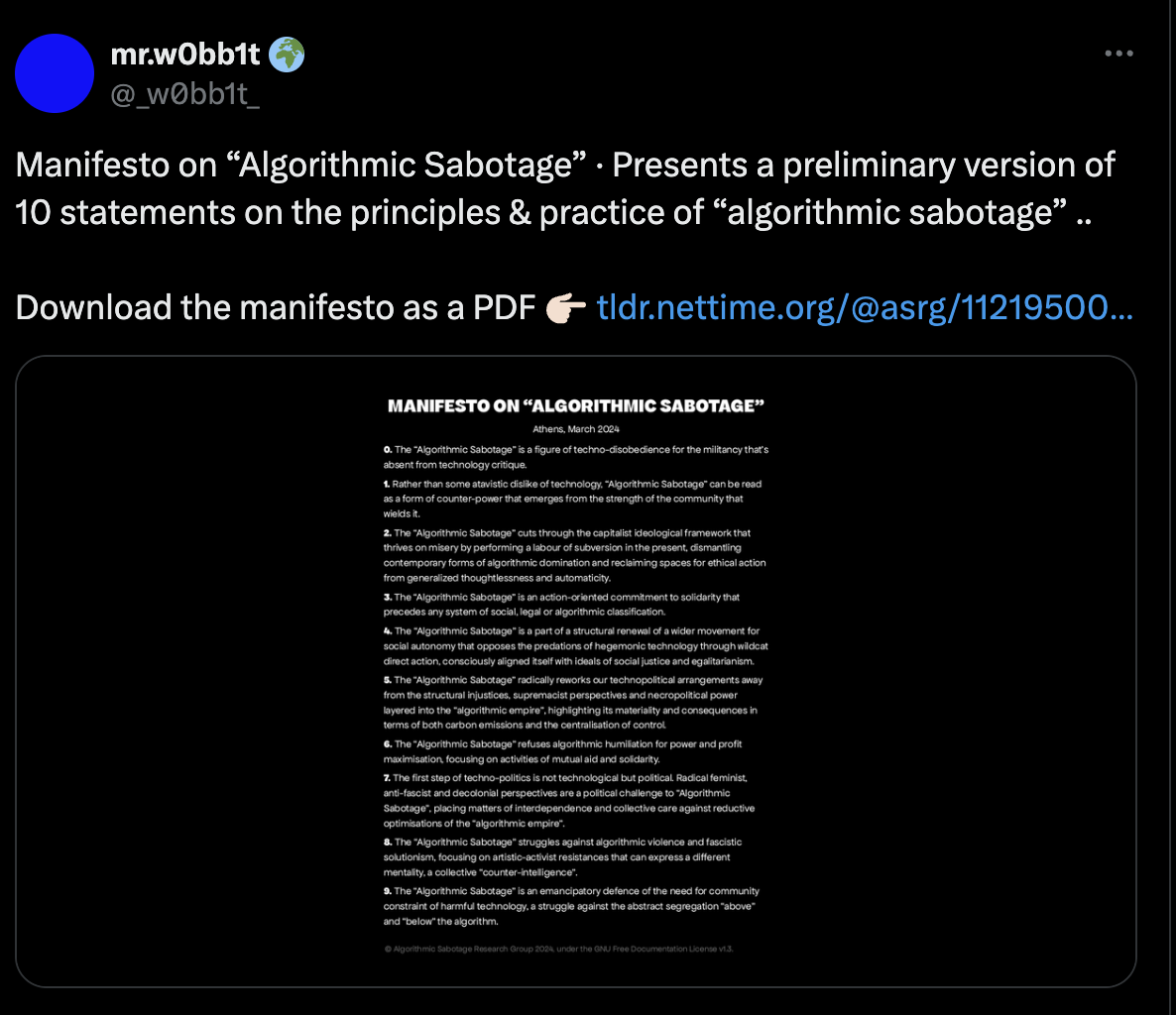
The post points readers to the document, MANIFESTO ON “ALGORITHMIC SABOTAGE” created by the Algorithmic Sabotage Research Group (ASRG) and described as follows:
[the Manifesto] presents a preliminary version of 10 statements on the principles and practice of algorithmic sabotage ..
… The #manifesto is designed to be developed and will be regularly updated, please consider it under the GNU Free Documentation License v1.3 ..
The struggle for “algorithmic sabotage” is everywhere in the algorithmic factory. Full frontal resistance against digital oppression & authoritarianism ..
Internationalist solidarity & confidence in popular self-determination, in the only force that can lead the struggle to the end ..
MANIFESTO ON “ALGORITHMIC SABOTAGE” – https://tldr.nettime.org/@asrg/112195008380261222
Tech industry critique is fixated on resistance to false narratives, debunking as praxis. This is understandable; the industry’s propaganda campaign is relentless and successful, requiring an informed and equally relentless response.
This traps us in a feedback loop of call and response in which, OpenAI (for example) makes absurd, anti-worker and supremacist claims about the capabilities of the systems its selling, prompting researchers and technologists who know these claims to be lies to spend precious time ‘debunking.’
The MANIFESTO ON “ALGORITHMIC SABOTAGE” is part of what I hope is a growing effort to not merely respond to capitalist socio-technical ideology on its own terms (the command and control vision of computation) but craft a competing vision and strategy of resistance.
The ‘Manifesto’ consists of ten statements, numbered 0 through 9. In what follows, I’ll list each and offer some thoughts based on my experience of the political economy of the technology industry (i.e., how computation is used in large scale private and public environments and for what purposes) and thoughts about resistance.
Statement 0. The “Algorithmic Sabotage” is a figure of techno-disobedience for the militancy that’s absent from technology critique.
Comment: This is undeniably true. Among technologists as a class of workers, and tech industry analysts as a loosely organized grouping, there is very little said or apparently thought about what “techno-disobedience” might look like. One thing that immediately occurs to me, what resistance might look like, is a complete rejection of the idea of obsolescence and adoption of an attitude of, if not computational perma-culture, the idea of long computation.
Statement 1. Rather than some atavistic dislike of technology, “Algorithmic Sabotage” can be read as a form of counter-power that emerges from the strength of the community that wields it.
Comment: “Counter power,” something the historic Luddites – who were not ‘anti technology’ (whatever that means) understood, is a marvellous turn of phrase. An example might be the use of concepts that hyper-scale computation rentiers such as Microsoft and Amazon call ‘cloud computing’ for our own purposes. Imagine a shared computational resource for a community built from a ‘long computing’ infrastructure that rejects obsolescence and offers the resources a community might need for telecommunications, data analysis as a decision aid and other benefits.
Statement 2. The “Algorithmic Sabotage” cuts through the capitalist ideological framework that thrives on misery by performing a labour of subversion in the present, dismantling contemporary forms of algorithmic domination and reclaiming spaces for ethical action from generalized thoughtlessness and automaticity.
Comment: We see examples of “contemporary forms of algorithmic domination” and “generalized thoughtlessness” in what is called ‘AI,’ particularly the push to insert large language models into every nook and cranny. Products such as Microsoft Co-pilot serve no purpose aside from profit maximization. This is thoughtlessness manifested. Resistance to this means rejecting the idea there is any use for such systems and proposing an alternative view; for example, the creation of knowledge retrieval techniques that are built on attribution and open access to information.
Statement 3. The “Algorithmic Sabotage” is an action-oriented commitment to solidarity that precedes any system of social, legal or algorithmic classification.
Comment: Alongside other capitalist sectors, the tech industry creates and benefits from alienation. There was a moment in the 1980s and 90s when technology workers could have achieved a class consciousness, understanding the critical importance of their work as a collective to the functioning of society. This was intercepted by the introduction of the idea of atomized professionalism that successfully created a perceptual gulf between tech workers and workers in other sectors and also, between tech workers and the people who utilize the systems they craft and manage, reduced to the label, ‘users.’ Arrogance in tech industry circles is common, preventing solidarity within the group and with others. Resistance to this might start with the rejection of the false elevation of ‘professionalism’ (which has been successfully used in other sectors, such as academics, to neutralize solidarity).
Statement 4. The “Algorithmic Sabotage” is a part of a structural renewal of a wider movement for social autonomy that opposes the predations of hegemonic technology through wildcat direct action, consciously aligned itself with ideals of social justice and egalitarianism.
Comment: There is a link between statement 3, which calls for a commitment to solidarity, and statement 4, which imagines wildcat action against hegemonic technology. Solidarity is the linking idea. Is it possible to build such solidarity within existing tech industry circles? The signs are not good. Resistance might come from distributing expertise outside of the usual circles. We see examples of this in indigenous and diaspora communities in which, there are often tech adepts able and willing to act as interpreters, bridges, troubleshooters and teachers.
Statement 5. The “Algorithmic Sabotage” radically reworks our technopolitical arrangements away from the structural injustices, supremacist perspectives and necropolitical power layered into the “algorithmic empire”, highlighting its materiality and consequences in terms of both carbon emissions and the centralisation of control.
Comment: This statement uses the debunking framework as its baseline – for example, the critique of ‘cloud’ must be grounded by an understanding of the materiality of computation – mineral extraction and processing (and associated labor, environmental and societal impacts). And also, the necropolitical, command and control nature of applied computation. Resistance here might include an insistence on materiality (including open education about the computational supply chain) and a robust rejection of computation as a means of control and obscured decision making.
I’ll list the next two statements together because I think they form a theme:
Statement 6. The “Algorithmic Sabotage” refuses algorithmic humiliation for power and profit maximisation, focusing on activities of mutual aid and solidarity.
Statement 7. The first step of techno-politics is not technological but political. Radical feminist,anti-fascist and decolonial perspectives are a political challenge to “Algorithmic Sabotage”, placing matters of interdependence and collective care against reductive optimisations of the “algorithmic empire”.
Comment: Ideas are hegemonic. We accept, without question, Meta/Facebook’s surveillance based business model as the cost of entry to a platform countless millions depend on to maintain far flung connections (and sometimes even local ones in our age of forced disconnection and busy-ness). The ‘refusal to accept humiliation’ would mean recognizing algorithmic exploitation and consciously rejecting it. Resistance here, means not assuming good intent and staying alert but also, choosing ‘collective care.’ This is the opposite of the war of all against all created by social media platforms whose system behaviors are manipulated via the use of attention directing methods.
The final two statements can also be treated as parts of a whole:
Statement 8. The “Algorithmic Sabotage” struggles against algorithmic violence and fascistic solutionism, focusing on artistic-activist resistances that can express a different mentality, a collective “counter-intelligence”.
Statement 9. The “Algorithmic Sabotage” is an emancipatory defence of the need for community constraint of harmful technology, a struggle against the abstract segregation “above” and “below” the algorithm.
Comment: Statement 8 conveys an important insight: what we accept, despite our complaints, as normal systems behavior on platforms such as Twitter is indeed “algorithmic violence.” When we use these platforms, finding friends and comrades (if we’re fortunate) we are moving through enemy terrain and constantly engaged in a struggle against harm. I’m not certain, but I imagine that by “fascistic solutionism,” the ASRG mean the proposing of control to manage control – that is, the sort of ‘solution’ we see as the US Congress claims to address issues with TikTok via nationalistic and thereby, fascistic appeals and legislation. We are encouraged by the ‘Manifesto’ to go beyond acceptance above or below ‘the algorithm’ to build a path that rejects the tyranny that creates and nurtures these systems.
Beyond Command and Control
In his book, ‘Surveillance Valley’ (published in 2018) journalist Yasha Levine traces the Internet’s use as a population control tool to its start as an ARPA project for the military. Again and again, detailing efforts such as Project Camelot and many others besides, Levine describes the technology platforms we see as essentially benign, but off course (and therefore, reformable) as a counter-insurgency initiative by the US government and its corporate partners which persists to this day. The ‘insurgents’, in this situation, are the population as a whole.
Viewed this way, it’s impossible to see the current digital computation regime as anything but a terrain of struggle. The MANIFESTO ON “ALGORITHMIC SABOTAGE” is an effort to help us get our heads right. From the moment of digital computation’s inception, war was declared but most of us don’t yet recognize it. In the course of this war, much has been lost including alternative visions of algorithmic use. The MANIFESTO ON “ALGORITHMIC SABOTAGE” calls on us to assume a persona (where resistance starts) of the person, and people who know they’re under attack and think and plan accordingly.
It’s an incomplete but vital response to the debunking perspective which assumes a new world can be fashioned from ideas that are inherently anti-human.
 Computational Impacts