Grapes of Metallic Wrath?

There are words, such as ‘freedom’ and ‘democracy’ which get tossed around like a cat’s toy, tumbling between meanings depending on the speaker. To this list of floating signifiers, we can add ‘automation’ which, when mentioned by business types, is meant to depict a bright and shining future but, when used by people on the left who, one would hope, are concerned about the prospects for labor, is typically employed as a warning of trouble ahead (there’s an exception to this: the ‘fully automated luxury communism’ folks, some of whom, seeing their robot butler dreams fade, are now turning to the polar opposite idea of degrowth).

The trouble with floating signifiers is that they float, making it difficult to speak, and perhaps think, with precision – actually, this also explains their appeal; any malcontent can shout they’re defending ‘freedom’ and fool at least some of the people, some of the time, via a socially agreed-upon vagary.

One of my quixotic preoccupations is a struggle against imprecise language and thought. It’s silly; we’re all over the place as a species and wouldn’t be human if it were otherwise (among my many arguments against the ‘AI’ industry crowd is its collective failure to understand that imprecision is a key element of our cognition, beyond duplication in electronic machinery)

So, with my quest for precision in mind, let’s spend a few moments contemplating automation, trying to put some bones and flesh on an ideological mist.

Check out the graphic shown below:

The Things to Think About and Study

I cooked up this image to visualize what I see as the appropriate areas of material concern for left politics. How do things work? And, for me, because this is my area of expertise, what role does computation play in the performance and command and control of labor in these various sectors of production?

In this post, I focus on automation in farming. Oh and by the way, my focus here is also on method, on how to think; that is, how to think in material terms about things which are presented in vague ways. 

Drones, Robot Tractors and Harvestors 

For me, the foundational, 21st century work on the real-world impacts of automation on labor is ‘Automation and the Future of Work’ by Aaron Benanav. Here’s a link to an article Benanav wrote for the New Left Review outlining his argument which can be summarized as: yes, of course, there’s automation and it has an impact but not as profound and far reaching, and not in the ways we are encouraged to think.

To look at farming specifically, I visited PlugandPlay, an industry and venture capitalist boosting website (trade publications, properly analyzed, are an excellent source of information) that published “How Automation is Transforming the Farming Industry”. 

From the article:

Farm automation, often associated with “smart farming”, is technology that makes farms more efficient and automates the crop or livestock production cycle. An increasing number of companies are working on robotics innovation to develop drones, autonomous tractors, robotic harvesters, automatic watering, and seeding robots. Although these technologies are fairly new, the industry has seen an increasing number of traditional agriculture companies adopt farm automation into their processes.”

https://www.plugandplaytechcenter.com/resources/new-agriculture-technology-modern-farming/

You can imagine a futuristic farm, abuzz with robotic activity, all watched over, to paraphrase the poet Richard Brautigan, by machines of sublime grace, producing the food we need while the once over-worked farmer relaxes in front of a panel of screens watching devices do all the labor.

Let’s dig a little deeper to list the categories of systems mentioned in the article:

  • Drones
  • Autonomous tractors
  • Robotic harvesters
  • Automatic watering
  • Seeding robots

For each of these categories, the PlugandPlay article, very helpfully, provides an example company. This gives us an opportunity to review the claims, methods and production readiness (i.e., can you buy a product and receive shipment and technical support for setup or are only pre-orders available?) of individual firms in each area of activity. This information enables us to add more precision to our understanding.

With this information at-hand, we’re not just saying ‘farming automation’ we’re looking at the sector’s operational mechanics.

For drones, American Robotics’ aerial survey systems are mentioned. As is my habit, I checked out their job listings to see the sort of research and engineering efforts they’re hiring for which is a solid indicator of real or aspirational capabilities. I’ve written about drone-based analysis before; it does have real world applications but isn’t as autonomous as often claimed.

The three examples of robotic harvesters listed are from Abundant Robotics, which is building specialized apple harvesting systems, Bear Flag Robotics, which seems to have retrofitted existing tractors with sensors to enable navigation through farming fields (and perhaps remote operation, the marketing material isn’t very clear about this) and Rabbit Tractors, which appears to be out of business.

There are a few other examples offered but hopefully, a picture is forming; there are, at this point, some purpose built systems – some more demonstration platform than production ready – which show the limitations, and potential usefulness of automation in the farming sector: perfect for bounded, repetitive applications (a weed sprayer that follows assigned paths comes to mind) not so great at situations requiring flexible action. Keep this principle in mind as a rule of thumb when evaluating automation claims.

It also isn’t clear how well any of these systems work in varying weather conditions, what the failure modes and maintenance schedules are and lots of other critical questions. It may seem cheaper, in concept, to replace workers with automated or semi-automated harvesters (for example) but these machines aren’t cheap and introduce new cost factors which may complicate profitability goals and it follows, adoption by agribusiness, which, like all other capitalist sectors, is always in search of profits.

So, yes, automation is indeed coming to, or is already present in farming but not, it appears, in the hands-off, labor smashing way we tend to think of when the word, ‘automation’ is tossed around, like a cat’s toy.

Next, time, I’ll take a look at automation in logistics. How far has it gone? How far will it go? 

How to Interpret Tech Propaganda (the case of the machine gun toting robot dog)

Usually, I try to start these essays with an anecdote to lead you, the esteemed reader, into my topic. These anecdotes lead me into a subject too; a warm up to get the writing process flowing.

For this brief essay, which is about yet another video posted to Twitter about a supposedly autonomous killing machine, I’m thinking of the classic shell game, which is described in this (obligatory) Wikipedia article:

The shell game (also known as thimblerig, three shells and a pea, the old army game) is often portrayed as a gambling game, but in reality, when a wager for money is made, it is almost always a confidence trick used to perpetrate fraud. In confidence trick slang, this swindle is referred to as a short-con because it is quick and easy to pull off. The shell game is related to the cups and balls conjuring trick, which is performed purely for entertainment purposes without any purported gambling element.

https://en.wikipedia.org/wiki/Shell_game

A confidence trick, a fraud. What do I mean when I use these words to describe the machine gun toting, robot ‘dog’?

After all, there is the machine and it’s gun. Where is the game?

Let’s look at the original post:

Tweet showing video of robot dog

The video shows a machine, very similar to Boston Dynamics’ Spot (which I discuss in this essay, Boston Dynamics, A Brief Inquiry) moving on a course with its spindly legs, firing an automatic weapon.

It’s implied that what we’re seeing is, as in that often cited Black Mirror episode ‘Metal Head‘, an autonomous machine which can roam on its own, killing people using some form of silicon intelligence, tuned for lethality.

What we’re really seeing is a remote controlled system, whose true purpose is obscuring the bullet’s source, the hand pulling the trigger.

The evidence is in the video.

The Controller and The Controlled

Take a close look at what we see in this still excerpt; a military transport vehicle, sitting idly by for no apparent reason. This is the controller, hidden in plain sight (the operator could just as easily have been outside) to give the appearance of autonomy.

The relationship between controller and machine is no doubt more or less what you see in this image of New York Mayor Eric Adams controlling a Boston Dynamics spot:

Now let’s take a closer look at the ‘dog’ unit:

A grounded, materialist, less science fiction informed examination of this image tells the story (well that, and the fact there is no machine Intelligence and certainly not within the form factor of this device): this is a remote controlled device, a drone. What appears to be a VHF whip antenna is clearly visible along with control interfaces and a camera for navigation.

One additional bit of information can be found in this image:

This shot, probably by accident because someone thought it was cool, reveals what’s behind the curtain: the camera’s view is directly of the gunsight which is certainly what the controller, sitting in the military transport vehicle, sees via a display. The robot ‘dog’ though it exhibits dangerous potential, is not the harbinger of a new form of self-directed killbot but rather, the harbinger of a new class of remote controlled drone, designed, like their UAV cousins, to obscure culpability.

What is the True Danger?

The 21st century isn’t going well.

In addition to climate change, the lingering possibility of nuclear war and the unraveling of neoliberal capitalism which, at the height of its power as a social form, was sold as being history’s last stage, we face the coming to earth of the military drone, long a menace to people around the world and arriving, as all military ideas eventually do, to a street near you.

So, we should agree there is a danger. But it’s not the science fiction danger of sinister machines, free of human control. It’s the danger of remote operated systems, used to harass and kill people while obscuring the source of this harassment and death. It’s easy to imagine a scenario: someone is killed by a police officer but the tools of body cams and eyewitness testimony are removed; the device from which the bullets flew is controlled by an unseen operator, indemnified from responsibility like the drone operators remotely flying machines over contested territory.

Earlier I mentioned the shell game which is this: the sleight of hand, performed via carefully shot marketing material, which leads our thoughts away from who is pulling the trigger into talking endlessly, and in terrified circles, about the same, tired science fiction tropes.

It’s time to put Black Mirror away to see the true danger taking shape, right before our eyes.

Boston Dynamics: A Brief Inquiry

As with death and taxes, you can be certain that whenever a video showing a Boston Dynamics robot is shared on Twitter, there are three reliable formulations:


1.) ‘Skynet’
2.) Robot overlords

3.) Techie admiration for engineering prowess

Typically missing are considerations of BD’s business model; who are the customers and what are these robots actually good for, if anything? I decided to do a bit of research – not very deep to be sure but, enough to go beyond social media flailing about.

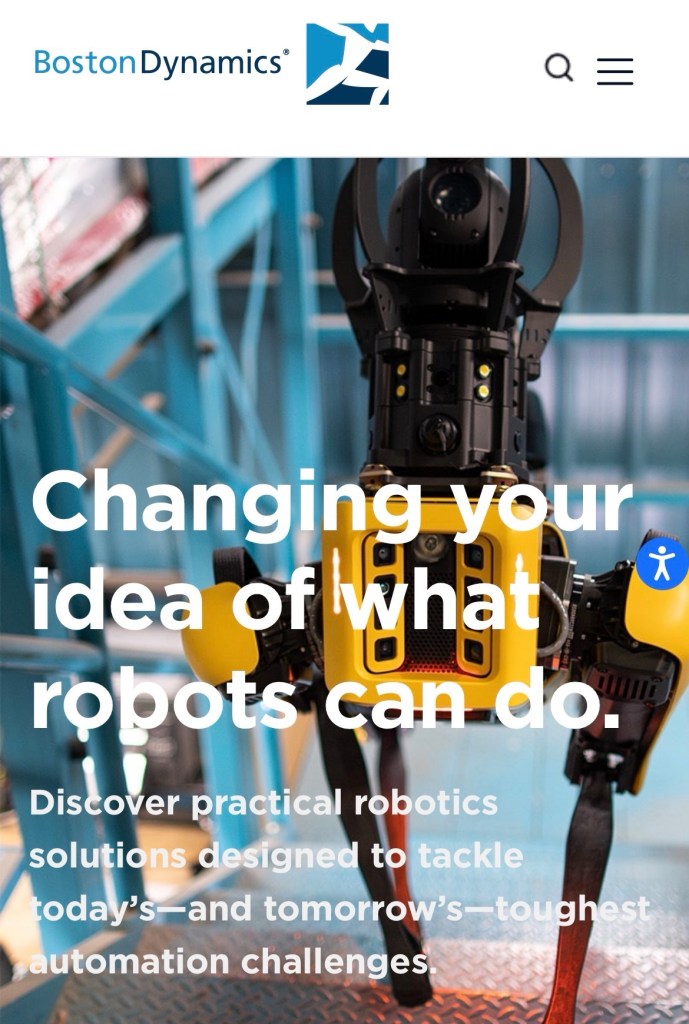
The sensible place to start was Boston Dynamics’ website which is, unsurprisingly, polished, showcasing production robots such as ‘Stretch‘, ‘Spot‘, ‘Pick’ and of course, everyone’s favorite dancer/supposed robot overlord, Atlas.

The production robot use-cases – per the website – are warehouse operations (where Pick seems a bit in the way) and hazardous conditions operations (Spot’s supposed value-proposition). I didn’t see mention of Spot’s use by police forces as a remote controlled proxy.

Let’s get to Atlas, which is usually the star attraction and undoubtedly a customer and investment attractor for BD. I found a presentation by Scott Kuindersma, Research Scientist and Atlas Project Lead which provides solid, down-to-earth information about how this robot works.

https://youtu.be/EGABAx52GKI?si=WVEsSh3BpKVP_m5U

Kuindersma describes Atlas as a demonstration platform. This is important to note because it separates this machine from production offerings. BD’s non-trivial achievement is building a system that can find its center of mass (a centroidal solution) and perform from a catalog of actions.

Atlas’ actions are defined ‘offline’ (i.e., virtually, via computational modeling) and then applied ‘online’ in the real-world. A system called Model Predictive Control puts Atlas’ library of motions to use while 3D plane fitting algos enable navigation through an environment.

As of June 2020, Kuindersma and his team’s focus was building a library of actions for Atlas that would enable it to perform parkour – or something close to it. This will surely be impressive and no doubt lead to further customers and investment.

Now, let’s ask ourselves, who is helped by BD’s work and what are the most likely use-cases? Videos of the warehouse robots show machines that seem slow and inefficient when compared to people. Boxes are moved from points A to B but lots of people – not shown in the videos – are surely required.

Spot, as we’re seeing, is finding use by police forces, for industrial inspection and by militaries. In a way, Spot can be viewed as an earth-bound drone. We can anticipate seeing it deployed in much the same way other remote operated devices are being used – for surveillance and perhaps distance violence.

Atlas, as a research platform, is obviously meant to both advance the state of the art and provide dream-fuel for those who long to see autonomous machines moving among us. The ‘AI’ dream is certain to be dashed but we can foresee remote operation scenarios that are just as dystopian.

Boston Dynamics efforts do bear watching. Not because Atlas – or some successor platform – will, Hollywood-style, grow weary of us and take over the world. Rather, that, as always, people will be behind the curtain, using the veil of machine distance to obscure culpability.